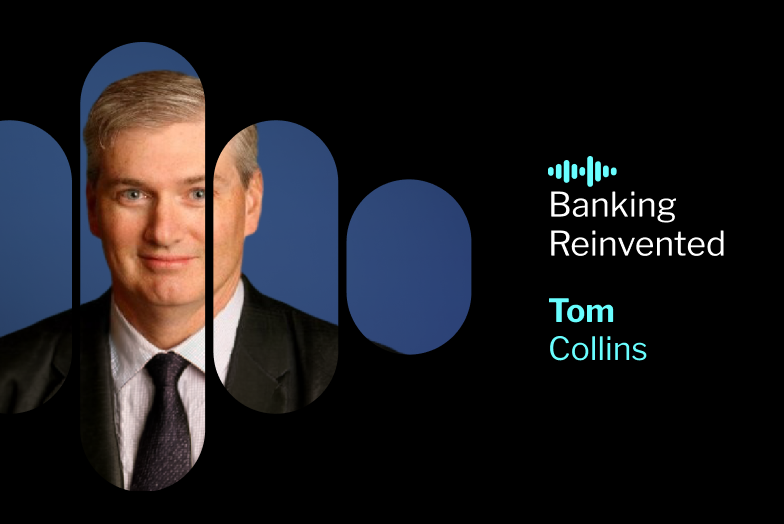
A senior banking executive walked out of a quarterly earnings call recently with a different feeling than usual. According to Tom Collins, senior partner and national commercial banking lead at West Monroe, the executive told him this was probably the last call where he could say the bank was "still trying to figure it out." The next call would need a real plan, or the market would punish the stock price.
That moment captures where commercial banking sits in 2026. Boards have stopped accepting "we're prioritizing use cases" as an answer, and already want proof.
This piece breaks down what Collins told Backbase's Banking Reinvented podcast: the five trends reshaping commercial banking right now, the AI use case most banks are still missing, and the five concrete recommendations he gives banks trying to move from pilot to production without breaking the relationship model the business runs on.
Collins highlights that client onboarding is getting finally treated as a competitive differentiator instead of a back-office chore, a shift Backbase has covered in depth. He notes that business ownership is transferring generationally, and the new owners expect banking on their own terms. Additionally, banks are chasing relationship primacy, hunting for white space to sell beyond the loan. AI investment has accelerated faster in the last two quarters than most banks planned for. Last but not least, small and mid-sized business banking is getting renewed attention as a deposit growth engine.
The AI use case hiding in plain sight: continuous relationship intelligence
Collins described a use case his clients are already getting results from: continuous monitoring of the relationship. Instead of waiting for a client to call or a quarterly review to catch a problem, the bank watches transactional and behavioral patterns across the portfolio as they happen.
The signals split into two types. One set flags risk: a sudden spike in line utilization, or an unusual transaction from a role that never does that kind of activity. Both point to fraud or emerging risk in the portfolio. The other set flags opportunity: a change in behavior that suggests a next-best-action moment, or early signs a client is getting ready to leave the bank.
Collins called the resulting system "a forensic sort of portfolio management capability." It identifies emerging risk, fraud, and revenue opportunity from that same transaction and behavioral data, before any of it reaches a human's inbox.
Today, an RM chasing those signals has to go into a dozen different systems to figure out which two or three conversations to have next. Continuous relationship intelligence turns that hunt into an insight pushed straight to the RM, instead of something buried in a system nobody checks.
Two versions of this use case, and why the distinction matters
According to Collins, this internal, forensic version of the use case is deliberately not client-facing. The value goes to the bank's own people first, so they can intervene before a client raises the issue.
He also describes a second, lighter version: in-app nudges that surface directly to the client, like flagging a transaction pattern that suggests a working capital problem with a prompt to learn more. That's a genuinely different, client-facing use case worth its own treatment.
This piece focuses on the internal version, since it's the one with the least existing coverage and the clearest near-term ROI.
Why this belongs to Relationship Intelligence, not another point tool
It's tempting to file continuous relationship intelligence under fraud detection or under RM productivity, but it's really neither. This is Relationship Intelligence: continuous, proactive signal detection that puts next-best-action insight directly in front of the banker managing that relationship.
The fraud dimension only becomes customer-facing once a signal turns into an actual case, at which point it hands off to a resolution workflow that contacts the client for proof of payment or funds. The everyday portfolio monitoring stays internal, which is exactly why most banks haven't built for it. It doesn't show up in a client demo.
According to McKinsey, relationship managers using AI-powered workbenches saw 9% portfolio growth over 12 months, against 5% for RMs without one, while also fielding five times more cross-selling ideas and spending 90% less time on account planning. That's the same logic behind continuous relationship intelligence: the RM acts on a signal instead of missing it. The earlier a signal reaches the right person inside the bank, the more of that value it captures before a client, or a competitor, gets there first.
Diagnosis isn't the hard part. Here's what banks are recommended to do
During the conversation, Collins tried to answer the harder question: how banks execute continuous relationship intelligence without breaking the RM model that still drives the business.
1. The unstructured data problem
Guarantor financials and personal financial statements mostly still arrive as PDFs, in a format the bank can't easily digest. That data already sits inside the bank, it's just never structured enough to use. The cost of leaving it unstructured shows up with the client. Collins warns: "Clients expect us to know this information." When a bank asks a client something the client thinks it should already know, it damages credibility instead of building it.
2. Choreograph how digital and physical interactions coexist
This is a distinct point Collins made, separate from RM training. As automation takes over transaction coordination, banks need to deliberately design how digital self-service and human RM conversations hand off to each other. Get this wrong, and the client ends up with two disconnected relationships, one with an app, one with a person, instead of one bank. Collins ties the choreography directly to what the RM needs to pull it off: the data and the training to know when a conversation calls for a human and when the digital channel already has it covered.
Banks have to decide, upfront, whether a moment belongs to the digital channel or to the RM. Then they need a plan for how the handoff between the two actually works. Skip that step, and the gaps between systems become gaps in the relationship.
3. You cannot flip a switch and call an RM a trusted advisor
Automating the tactical side of the RM role does not automatically turn that person into a strategic advisor overnight. "It's going to require some human capital management," Collins said, and it takes real time.
Practically, that means training RMs to hold a different kind of conversation: asking about new product lines and working capital needs 12 months out, instead of chasing last quarter's financials for a renewal. Not every RM in the role today will make that transition successfully, Collins added, which is why banks need a deliberate plan for who moves into the advisor seat.
4. Fewer, more skilled RMs beat more, less-equipped ones
Collins ties the RM count directly to capacity. As mundane tactical work gets automated, an RM's freed-up time lets them responsibly cover a broader portfolio. He expects that to mean fewer RMs overall, each managing more relationships, and each more skilled than the transactional role demands today.
This tracks with the wider data on where RM time actually goes. BCG research shows RMs in US commercial banks can spend up to 60% of their time on internally-facing administrative tasks with little effect on client satisfaction or revenue. Free up that time responsibly, and coverage capacity rises without adding headcount. It's the same math behind how commercial banks fix RM productivity without adding headcount.
5. Invest now, or become someone else's acquisition target
According to Collins, banks that keep investing in AI, platforms, and data programs will have the efficiency to stay independent and acquisitive. Banks that don't, in his words, "are probably setting themselves up to be acquired." He named Backbase directly as one of the investments he sees separating what he called the industry's coming haves and have-nots.
Collins pointed to "a strong bias in the market these days around consolidation." His reasoning: "your acquisition capital is your share price," and share price comes down to how well a bank drives efficiency and growth. Invest in that efficiency, and a bank stays the acquirer. Skip it, and a bank becomes the target.
"It's not too late for banks to figure this out," he said, while adding that the stakes now run "from the big banks down to the smaller banks."
Why this breaks without a unified foundation underneath
Investing in AI only pays off if it lands on the right foundation. None of the five recommendations above work if the signals feeding them come from a disconnected system. Continuous relationship monitoring needs a real-time, shared view of the client across lending, treasury, payments, and credit. That's a single source an RM works from directly, instead of one more dashboard stacked on top of the systems they already have open.
Fragmented architecture, on the other hand, is what keeps cost-to-income ratios stuck above 60% industry-wide, even after years of front-end investment.
This is the case for connecting Relationship Intelligence and Customer Operations into one shared context. Running them as separate, disconnected tools defeats the point. Fraud, risk, and attrition signals only compound in value when they draw from that same context. It has to reach the RM's next-best-action, the credit team's exception queue, and the compliance team's audit trail at once. The Banking OS is what makes that possible: the shared foundation powering both solutions instead of splitting them apart.
Governance matters as much as the data model underneath. The monitoring system only flags a pattern. The moment that flag becomes a case, whether a fraud hold, a client outreach, or a credit action, something is now acting on the bank's behalf. That handoff needs a clear, auditable trail: what triggered it, who approved it, what evidence supports it. Skip that step, and nobody can explain afterward why the bank acted.
What this means for your commercial banking operating model
- Build continuous, internally-facing relationship monitoring first. It's lower risk, and Collins points to it as the use case with the clearest near-term return.
- Structure the unstructured data before anything else. Guarantor financials and personal financial statements sitting in undigested PDFs are the actual credibility risk with clients, not a generic governance gap.
- Design the digital-to-human handoff deliberately. Decide upfront which moments belong to each channel.
- Budget time and training for RMs to become advisors. The tech transition and the human transition are two different projects.
- Plan for fewer, higher-capacity RM roles. Automation frees RM time, and that freed-up time is what lets each RM cover a broader portfolio.
- Treat platform investment as a defense against consolidation. Collins ties it directly to staying the acquirer instead of becoming the target.
Frequently asked questions
What does a modern commercial banking operating model need from AI?
It needs a unified view of the client across lending, treasury, and payments so AI-driven signals, whether fraud, credit risk, or attrition, reach the right person with full context, governed by a clear authority trail rather than sitting in a disconnected point tool.
What is continuous relationship intelligence in commercial banking?
It's ongoing, AI-driven monitoring of a commercial client's transaction and behavioral patterns to surface emerging credit risk, fraud, and attrition signals directly to the relationship manager, before the client raises an issue.
Is this the same as AI-powered onboarding or RM productivity tools?
No. Onboarding automation speeds up account opening. RM productivity tools remove administrative work. Continuous relationship intelligence is a separate, ongoing signal-detection layer running on the existing portfolio.
Why do banks need data governance before deploying this kind of AI?
Signals from incomplete or unstructured data create false positives and erode client trust. Tom Collins points out that clients expect their bank to already know basic information about the relationship.
How does this connect to Backbase's platform?
Relationship Intelligence runs on the Banking OS, giving RMs proactive, next-best-action insight from a unified view of the client, with Customer Operations resolving any signal that escalates into an actual case.