Let’s build your 90-day launch plan
See how the Banking OS coordinates your customers, employees, and AI agents into one operating model.
AI is everywhere in banking. Measurable ROI is not.

Without proof of ROI, digital innovation dies in committee. This leaves the customer relationship, revenue, and market share vulnerable to AI-native competitors.
Proving the return
61%
of bank CEOs face pressure to prove returns, yet only 14% of CFOs report seeing any ROI.
This blueprint delivers a phased strategy to defend your budget and ship quick AI wins. These investments compound to unify the digital experience across touchpoints. A capability framework upgrades your platform, step by step.
01
For decades, banks held an uncontested monopoly on the customer relationship. The bank was where people deposited paychecks, paid bills, and turned for advice on the biggest financial decisions of their lives.
Today, that direct relationship is eroding. Technology, customer expectations, and outside competition are all moving faster than most banks can respond to.
Doing nothing is no longer an option. The banks that act now will set the standard. The rest will spend the next decade explaining to their board and investors why they didn't act sooner.
BCG
1 in 4
banks worldwide use AI to gain any real competitive advantage. Most are spending without seeing any payoff.
Threats
01
Trend
Most banks now run AI in production, but it lives in isolated pockets - a chatbot in retail, a fraud model in compliance, an automated workflow in lending - each siloed from the rest of the bank.
Risk
Every one of those systems generates real insight about the customer, but none of it talks to the others. Across the industry, roughly half of all frontline work lives in the whitespace between systems. This inconsistency erodes trust and pushes volume back into the contact center.
Opportunity
A single Banking OS closes that gap by giving every channel and every AI agent the same context. Nexus, the Banking OS's memory layer, maintains one Customer State Graph, so a conversation that starts in the app and finishes on a call remembers everything in between. One profile, one brand experience, no matter the channel.
02
Trend
The first wave of GenAI deployment resulted in a flood of shallow "chat wrapper" implementations, leaving consumer patience at an all-time low.
Risk
Gartner found that only 14% of customer service issues get fully resolved in self-service, with customers rating chatbots less convenient, less time-saving, and less useful. Even issues deemed "very simple" only resolved 36% of the time. This forces frustrated customers into the call center, skyrocketing the bank's cost-to-serve.
Opportunity
Banks that move past conversational wrappers to reasoning-native agents differentiate themselves immediately and win back customer trust. These agents verify eligibility, apply policy, and finish the task inside the same chat window.
03
Trend
Fintech (Revolut, Chime) has chipped away at retail primacy for years. Now Big Tech and Frontier AI Labs (Anthropic, OpenAI) are going further, embedding directly into financial workflows and core infrastructure, becoming the default operating layer.
Risk
When a third-party app becomes the customer's daily dashboard, that brand becomes the trusted voice. It owns the advice, wealth decisions, and credit origination. The bank's brand disappears from daily life, and with it goes customer loyalty and future ecosystem revenue.
Opportunity
The bank still holds an advantage no fintech app can copy: the primary financial data itself. Reward customers for connecting more of their outside accounts, by offering better rates or waived fees. Make your bank's AI the visible, trusted voice in that relationship, so customers think of your bank first, not last.
04
Trend
External AI agents and financial assistants are becoming the primary consumer interface. Traditional banks are losing real-time visibility over customer intent and idle capital.
Risk
Margin erosion and asset flight. A third-party AI might sweep idle cash into a high-yield account today and rebalance a portfolio into an outside robo-advisor tomorrow. Each move drains liquidity, data, and cross-sell opportunities. The bank ends up as the plumbing: a low-margin utility that only clears transactions and holds custody.
Opportunity
Embedded, native agentic AI lets the bank spot and act on the same opportunities first across deposits, credit, and investments. That shift, from passive account host to proactive advisor, keeps high-value products and assets moving through the bank instead of around it.
05
Trend
Customers do not think of their bank in terms of organizational silos (retail banking vs. fraud vs. mortgage). They simply have a singular financial objective that they expect to complete immediately.
Risk
Traditional customer loyalty metrics are decaying. Consumers now measure digital maturity by the amount of manual labor an institution eliminates for them. Forcing a user to break away from a digital interaction to do manual tasks damages engagement and drives silent abandonment across your product lines.
Opportunity
Update KPIs to prioritize resolution over response time. When specialized agents complete a multi-step request in a single, unbroken session, that speed becomes the thing competitors can't easily copy.
06
Trend
Regulatory bodies, compliance departments, and data privacy authorities are rapidly tightening scrutiny on how consumer-facing AI models handle customer data, algorithmic bias, and decision explainability.
Risk
Unchecked LLM implementations that rely on 'black-box' prompt-wrapping create real regulatory and legal exposure. A single hallucinated piece of financial advice or one data exposure that can't be explained can mean regulatory fines, compliance audits, and lasting brand damage.
Opportunity
Build ironclad governance directly into your operational architecture rather than trying to patch it on after the fact. Every action an agent or human initiates must run through a policy check first. It then generates a permanent decision token before execution. This creates an unalterable, queryable audit trail of what was decided, under which specific policy, and by which actor. Safe autonomy becomes a core business driver.


With Backbase, we gain more than a platform, we gain momentum. They provide a future-ready foundation and the freedom to plug in best-in-class partners, accelerating innovation at every turn. That kind of adaptability makes all the difference.
Harvey Libarnes
Where to start · checklist
List every AI model or vendor tool currently running somewhere in the bank. Can anyone name them all? Note how much data, if any, moves between them.
Review your chatbot logs. What percentage of sessions end with the AI fully completing a task, versus handing off a link, a form, or a phone number?
Quantify how many active retail and commercial customers already link accounts to outside fintech aggregators. Then compare month-over-month holdings for those accounts against your benchmark. Every point of decline you find is the cost of doing nothing, priced in real dollars.
Quantify how much high-value liquidity sits in dormant, low-yield products today. That's the exact balance a competitor's AI is watching for.
Map how many customer requests require more than one handoff or system to reach resolution. Note where in that chain customers give up.
Benchmark your current AI roadmap against local compliance requirements for model explainability, bias, and third-party data exposure.
02
The risks in Chapter 1 don't mean banks are losing this fight. They set up the biggest growth opportunity banks have had in years: historic opportunity for growth, retention, and market leadership. Banks already hold what no fintech challenger has: years of transaction history and a regulated core.
However, this opportunity is not open to everyone. That advantage only pays off for leadership teams who understand exactly where their AI sits on the maturity curve and are committed to outpacing the competition.
Most institutions treat any conversational interface as proof of a modern AI strategy, lumping automation and autonomous execution together as if they're the same thing. They aren't. The gap between an AI that talks and an AI that acts is the difference between frustrating the customer and delighting them.
Three distinct tiers exist, but most banks are further behind on this curve than they think:

Standalone tools that rely on pre-programmed decision trees and static FAQ matching. Cut off from core banking systems, they cannot access real-time data. Instead, they answer basic queries and route complex requests to static help articles or live phone numbers.
Virtual agents, bots, or voice assistants that interact with customers through spoken or written natural language. By accurately understanding user needs and securely connecting to live systems, they can autonomously execute routine, rule-based tasks.
Reasoning-native agents integrated into a unified, governed operating layer across core systems. These autonomous systems evaluate eligibility, enforce policies, and execute complex workflows end-to-end, generating an auditable trail for every decision and action.


The next decade won’t necessarily belong to the biggest banks, it’ll belong to the fastest learners. Those that unify data, channels, and AI into one intelligent platform will close the gap with digital natives and redefine what banking means.
Henning Soller
Where to start · checklist
Review your digital banking API architecture. Document how many customer-facing APIs are read-only versus how many support write commands. Note how many of those write actions are policy-checked or logged.
Map your top five digital service requests. Count how many times a customer switches channels, mobile to web, chat to phone, just to finish one task.
List every chatbot, conversational AI, or point-solution vendor you already use. Check whether each one runs in isolation, or check whether it connects into a shared system that carries data and logic across the bank.
03
Transformation efforts routinely stall at the same internal debate: Do we first fix the entire core architecture, or do we wait until the organization is AI "ready"?
Neither gets you moving.
This blueprint is designed to meet your bank exactly where it is today, regardless of your current stack or digital maturity. Incremental proof builds internal consensus, and consensus unlocks the resources needed to scale horizontally and vertically.
The Reality Check: The era of the multi-year, "big bang" IT overhaul is over. No one wants to defend a 7- or 8-figure budget allocation, only to wait 3 years to see if it moves the needle on the P&L.
To protect your budget and maintain momentum, each phase of this blueprint is specifically scoped to deliver localized, undeniable value fast enough to prove the business case in months, not years.
01
Each entry point below breaks into three phases: Crawl, Walk, and Run.
These aren't sequential stops on one path, and they aren't mutually exclusive. A bank with the resources and the appetite can run missions in all three at once, across different teams, each moving through its own crawl, walk, run. A bank running lean, or piloting the model for the first time, might prove the model in one domain before opening a second. Either way, the real question is which pain is loud enough right now to justify moving on it.
How to find your starting point: If you can confidently check all the requirement boxes today, you've already cleared it; move to Phase 2 and evaluate again. The first phase where you cannot check every requirement box is your real starting point.
Pain points
Customers abandon digital journeys the moment a system asksthem to download a PDF, print a form, or call a support line to finish what they started.
Nedbank needed to handle banking questions for 7 million customers without growing its contact center. Their AI assistant, Enbi, now resolves those requests in the chat window, fielding more than 10 million conversations. Live chat volume to contact-center agents dropped 70%. Nedbank credits Enbi with helping 744,000 customers solve problems without picking up the phone.
Learn how →conversations fielded by Enbi, Nedbank's banking assistant
Pain points
Operational friction breaks in both directions: handling reactive inbound cases and managing delayed outbound outreach. This double failure swells support queues and pushes cost-to-serve beyond what headcount or budgets can absorb.
I&M Bank wanted to scale their customer acquisition without compliance infrastructure or customer satisfaction scores breaking under the pressure. On a unified digital platform, they grew new customer onboarding from 2,000 to 21,000 accounts per month, doubling active customer base to 600,000 while maintaining a world-class NPS of 75+.
Learn how →growth in monthly onboarding — from 2,000 to 21,000 new accounts
Pain points
Customers expect their bank to actively work for them. Fintechs and Big Tech are winning customer loyalty with proactive agents. Theseagents automatically optimize cash, manage wealth, and guide everyday financial choices. Banks generate this same relationship intelligence everyday, across every chat, case, and transaction. Almost none of it gets used. Whoever acts on that intelligence first keeps the relationship. Right now,that's rarely the bank.
Gartner
of agentic AI projects will be canceled by 2027
Regulatory exposure doesn't sit inside one department. It follows every piece of data and workflow across all three entry points. That's why every agentic action runs through the same governed check, whether it's a chat reply or a credit decision. Nothing executes without leaving an audit trail.
The reality check: Gartner predicts more than 40% of agentic AI projects will be canceled by 2027. The reason: unclear business value, or risk controls that never got built. The policy check in Phase 1 is how you rule out the second reason, even for the smallest request.
04
Every banking executive is trapped in the same loop. They pour millions into AI and still can't point to one line item on the P&L that actually shrank as a result.
The real gap is measurement. Whether you're a product manager pitching your VP, a business unit head defending budgetary asks to the CFO, or an executive updating investors, the trap is the same: reporting technology metrics when the organization wants business outcomes.
If you want internal buy-in, you have to speak the language of the business.
01
Traditional AI programs rely on "containment" and "deflection." These are internal IT metrics. They live inside isolated systems and tell you nothing about the health of your bank. To secure continuous funding, you must translate technical actions into tangible outcomes.
The reality check
61%
of CEOs face intense pressure to demonstrate tangible returns on AI, yet only 14% of CFOs report measurable ROI today.
01
A single metric is just a data point. Combined, these five numbers tell the exact story board members are desperate to hear: How AI investments lowered operational friction, deepened customer loyalty, and drove business growth that scales without adding headcount.
Grow lending volume by 20% while holding servicing headcount flat breaks the linear relationship between scale and cost. That is the sentence that wins board approval and funds your next phase of investment. A 75% chatbot containment rate, on the other hand, never will.
Where to start · checklist
Review what you report today. Are you tracking isolated IT vanity metrics like containment, or strategic outcomes that prove financial impact to the board?
Compare volume growth against headcount growth in one domain over the past year. If volume grew faster than headcount, you already have an elastic operations story to tell.
Document starting numbers for each of the five KPIs before launching to track progress over time, prove tangible impact, and calculate true ROI.
05
When a technology category moves as fast as agentic banking, vendor fatigue is inevitable. Every legacy platform, chatbot wrapper, and point solution has suddenly rebranded itself as "agentic."
To cut through the marketing noise, you need an evaluation framework based on architectural reality, not slide decks. The success of your AI roadmap depends on four structural pillars: Context, Orchestration, Authority, and Intelligence.
Use the matrix below to pressure-test your existing technology stack, your current roadmap, or any vendors you plan to evaluate. Prioritize each capability based on your current goals and scope.
KPMG, 2026 Banking Technology Survey
71%
of banking leaders agree that theirorganizations need to invest in modernizingplatforms to bring new or enhanced productsand services to the market.
01
Chances are, your team is already managing the symptoms: a virtual assistant customers avoid, or a routine servicing query that takes four disparate tools and multiple manual handoffs to resolve.
These friction points are not team or operational failures. They are the predictable outcome of deploying point-solution AI on fragmented enterprise architecture. Solving this doesn't require tearing out core infrastructure.
Backbase offers an AI-native Banking OS that layers on top of your existing systems, unifying customer touchpoints, frontline teams, and backend workflows into one governed execution layer as the foundation for true agentic execution.
“Backbase provides a 'Banking OS' that unifies a bank's frontline operations, with a platform the bank and third-party tech companies can build on top of. Its semantic layer is a competitive advantage, strengthening banks' ability to adjust and innovate going forward... Backbase offers superior agentic AI, with agents for data retrieval and classification.”
The Forrester Wave™
01
Operating as a single execution layer, Backbase unifies service, operations, and intelligence into one connected system. The table below illustrates how this translates into business impact.
Forrester Wave
Highest in Strategy. Highest in Offering. Customer Favorite.
Forrester surveyed customers of each vendor evaluated. Backbase scored highest of all 11 vendors on both axes with a 4.54 on Current Offering and a 4.30 on Strategy.
Most vendors near the Leaders zone lead on one axis but only rank as Strong Performers on the other. Backbase led both, outscoring vendors that have run banking's core systems for decades, with its own customers rating it the favorite.
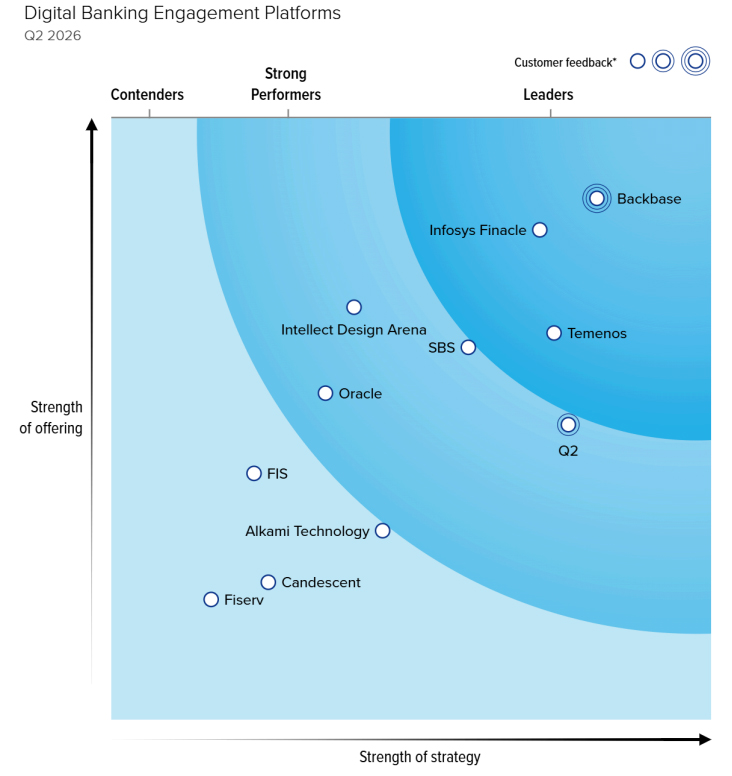
“Customers would enthusiastically select Backbase again, citing high trust and the platform's flexibility and foundational layers that give banks the ability to try out and test new ideas. Backbase is a Customer Favorite in this evaluation.”
The Forrester Wave™
01
Start with a single high-impact use case. We integrate your existing systems, establish governance, and bring you to live production with measurable ROI.
Evaluate your current tech stack and identify immediate operational friction across frontline and self-service touchpoints.
Build a custom business case projecting CSAT gains, cost-to-serve reductions, and FTE capacity expansion for leadership.
See Backbase agents and unified workflows running real banking journeys, governed at every step, on your infrastructure.
Table of contents
Chapter 16 threats to retention & scale
Chapter 2Chatbots vs. Conversational AI vs. Agentic Banking AI capability comparison
Chapter 3Phased Blueprint to Agentic Banking
Entry point 1: Conversational banking
Entry point 2: Customer operations
Entry point 3: Proactive advisory
Chapter 4Measuring your AI Success
Chapter 5Building Your Functional Requirements
Prefer to read offline?
Download the full whitepaper. 30 pages, 5 chapters, every checklist included.
See how the Banking OS coordinates your customers, employees, and AI agents into one operating model.