.png)
Eugene Deeny is principal industry advisor at Endava, a global technology services firm with a longstanding partnership with Backbase. He joined Backbase's Banking Reinvented podcast, to talk about the gap between how ready banks say they are for agentic AI and how much they've actually invested.
Endava's own research, surveying 1,000 senior leaders across financial services and fintech, found that 92% feel prepared to deploy agentic AI. Only 36% have a fully funded strategy to do it.
That gap usually gets explained one of two ways: not enough governance, or not enough clean data. Deeny's argument is that both explanations miss the real blocker: the org chart.
It isn't a governance problem or a data problem
Data modernization and AI governance are two of banking's most heavily funded AI investments right now. Both matter, but neither one, on its own, closes the readiness gap.
Deeny's diagnosis is different: the problem is how banks are organized. Most banks are still structured around product silos, not around the customer journeys an AI agent needs to operate across. That structure, not the model or the governance policy, is what breaks first.
Silos don't just slow a bank's transformation in the abstract. They hand every new AI agent the same broken handoffs the humans already had.
Banks have already spent heavily on data modernization and AI governance. Neither one touches the actual constraint. A recent Forbes Technology Council analysis of banking's AI problem stated that hundreds of millions of dollars get poured into cloud programs, infrastructure improves, and PowerPoints signal transformation, but fragmentation, data silos, and conflicting taxonomies simply migrate to a more modern environment.
In other words, the technology gets newer, but the fragmentation doesn't, because a cloud migration doesn't change who is accountable for a customer's journey.
The other explanation banks reach for is governance. Backbase has argued that AI governance has to be built into the architecture, not added on top after deployment. Still, governance answers a narrow question: is this action allowed, and can we prove it happened.
Governance doesn't answer who is accountable when a customer's application sits between three departments for a week with no owner. That is a different failure mode, and no governance framework, however well built, was designed to fix it.
This lines up with what McKinsey has argued for years about bank transformation generally: siloed structures hamper organizations' ability to transform themselves.
Read more: What is the AI-Native Banking OS - and why do banks need it?
The org chart is the real blocker for AI in banking
Deeny's fix for the AI readiness gap in banking comes down to ownership.
Most banks are structured around products and departments: mortgage, SMB, commercial, cards. Each built its own systems, its own data, and its own version of the customer, often over 25 to 35 years. A customer moving from onboarding to servicing to a credit decision crosses three or four of these silos, and no one owns the journey end to end.
The relationship manager, the branch teller, the call center rep - someone always had to stitch together an answer across departments that don't share context.
The organizational structure most banks operate in today was not designed for AI. It was designed for silos, and the human has always been the glue in between.
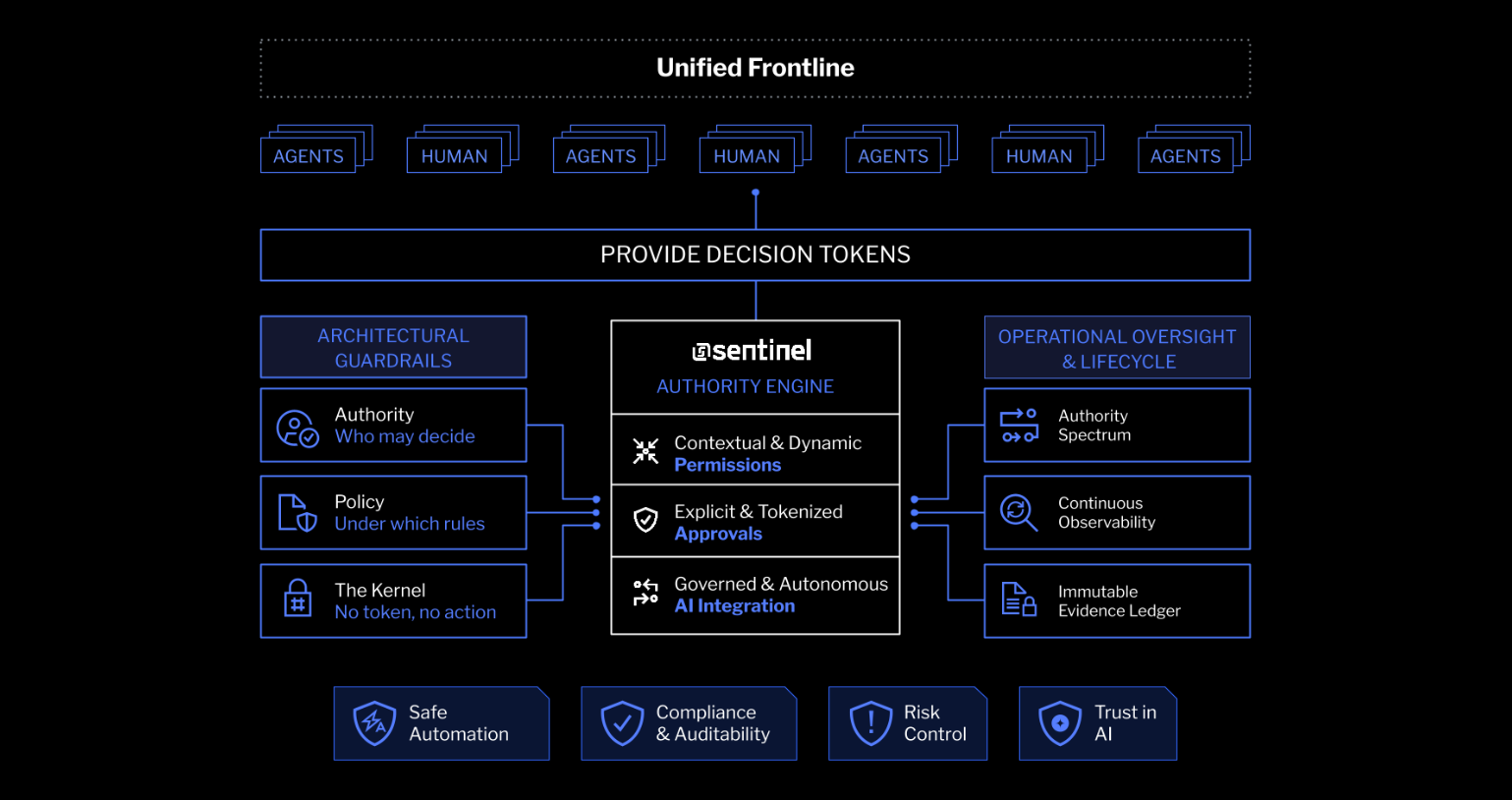
That's the same whitespace problem Backbase has mapped across the Unified Frontline: fragmented ownership creates the gaps no system, and no agent, can close alone.
Deeny's prescription is a shift to understanding value streams versus product or operational silos.
A value stream owns a customer journey front to back, such as mortgage origination or SMB onboarding, instead of handing a customer between departments that do not share context.
He points to business onboarding as an example. Some banks still take 20 days to open a business account, and that is not going to work in tomorrow's world. The delay isn't a data problem or a compliance problem. It's that no single team, and no single line on the org chart, is accountable for the full 20 days.
Not every part of the bank feels this the same way. In the podcast episode, Deeny drew a line between routine work and regulated decision-making.
What a value stream gives agentic AI that governance and data can't
A value stream gives agentic AI something a data platform alone cannot: one team, one set of metrics, and one consistent view of the customer that travels with them across every step.
Without that ownership structure, every new AI agent inherits the same handoffs the humans were already drowning in. You can unify the data and still have four teams disagreeing about who owns the exception.
Reorganizing around the journey removes that disagreement before the agent ever gets deployed.
Deeny made one more point about how banks set up their AI rules: Banks usually argue about how to organize that governance. Should one central team write the rules for every AI agent in the bank? Or should each business unit, like mortgages or SMB banking, set its own rules?
Deeny thinks that argument is beside the point. In his view, either approach works, as long as the rules are built into the system itself, and someone actually checks that agents follow them.
Where silos cause trouble in banks
Say a loan application needs an AI agent to pull data held by three different departments. If something goes wrong, whose job was it to catch it? In a siloed bank, it is often nobody's, because no single team owns the process from start to finish.
That's what a value stream fixes. One team owns the customer's journey, like the loan application, from beginning to end. With one team accountable, governance has an actual owner to hold, instead of getting split across departments that all assume someone else is checking. Governance stops being everyone's job and nobody's job. It becomes a job someone has.
Deeny notes that when you move into regulated process areas, like decision support, automated decisioning, and other regulated operational workflows, the grip tightens. This is not just from a regulatory and control perspective, but from a technical and infrastructural one.
That difficulty is exactly why sequencing matters. Start with the value streams where the stakes are lower, prove the model works, and bring in the regulated, high-scrutiny journeys once the ownership structure and the infrastructure can actually support them.
Continue reading: The Unified Frontline: AI in banking starts below the surface
Three questions before your next agentic AI investment
Deeny's closing point for bank boards: The shift away from an incremental improvement mindset means banks have to reimagine how they operate.
Before the next AI governance review or data project, three questions cut faster to the real issue:
- Does one team own each customer journey front to back, or is it still split across product silos?
- When a customer moves between departments, does context travel with them, or does someone re-enter it?
- If an agent got deployed into that journey tomorrow, is there one owner accountable for how it performs?
Backbase's approach to progressive modernization is built for this kind of shift. Banks modernize one domain at a time, what Deeny would call a value stream, through a 90-day launch with clear economic targets instead of restructuring the whole bank at once. Nexus, the operational memory layer of the Banking OS, gives every agent inside that domain the same shared customer context, so reorganizing around journeys doesn't mean rebuilding data infrastructure from scratch each time.
To learn more, book a strategy consultation.
FAQ
What is a value stream in banking?
A value stream is a customer journey owned front to back by one team, such as mortgage origination or SMB onboarding, instead of split across separate product and operational silos.
Why do product silos block agentic AI in banking?
An AI agent deployed into a journey that spans multiple silos inherits the same handoffs and context loss that slow down human teams. One team owning the full journey removes that fragmentation before the agent is deployed.
Should banks centralize or decentralize agentic AI governance?
Either model can work. The deciding factor is whether one team is accountable for each customer journey, so governance has a clear owner to monitor rather than trying to referee across silos.
How does agentic AI eliminate operational silos in banking?
It doesn't on its own. Agentic AI deployed into a journey still split across product silos inherits the same broken handoffs the humans had. Silos get eliminated when one team owns a customer journey front to back, a "value stream," so every agent in that journey works from the same context and the same accountable owner, instead of four departments each owning a piece.