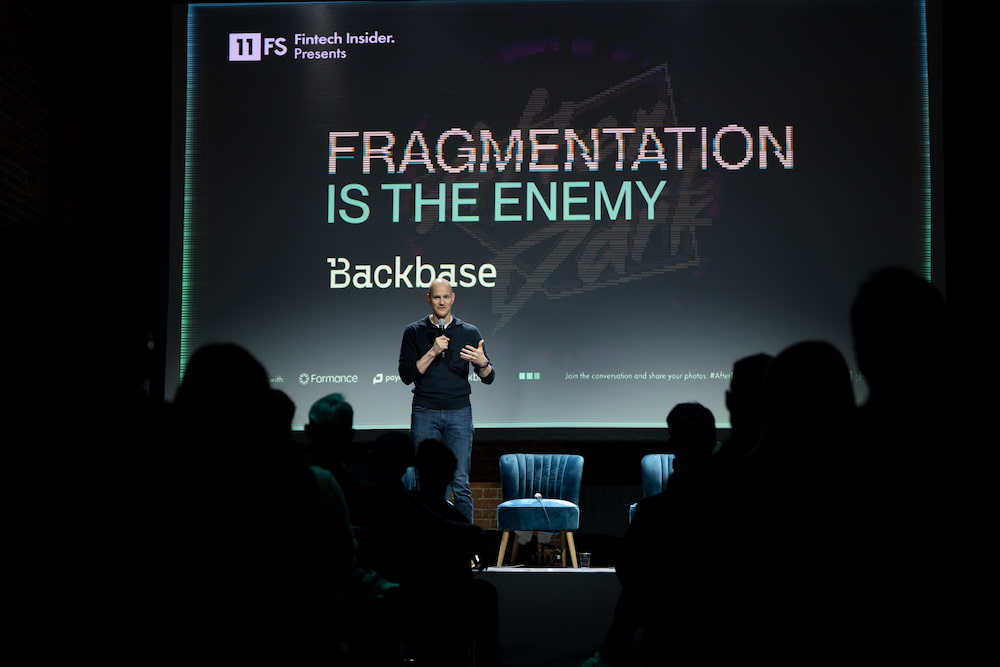
I had the privilege of taking the stage at 11:FS After Dark in London in front of a room that included some of the sharpest minds in banking. I opened with three questions:
Question 1: Who in the room is completely fed up with AI hype? Most hands went up.
Question 2: Who is currently deploying AI agents in production at scale, with meaningful impact across the board? Only 3 people raised their hands.
Question 3: Who believes AI will fundamentally transform the way banks operate in the next five to ten years? Nearly every one in the room had their hand up.
The gap between AI's promise and AI at scale in banking is real, and I was there to unpack the reason behind it and to introduce a new category built around the answer: the Unified Frontline.
The problem nobody puts in the board deck
Most banks think their operations are running smoothly, with each system handing off work to the next. Whether it's core banking, payments, cards, risk, or the CRM, each system is optimized for its own function.
In reality, however, approximately half of all frontline banking work lives in the whitespace between systems. It manifests itself in all the manual work in the form of handoffs, exceptions, coordinations, copy-pasting, and the "let me check with someone and get back to you."
In a typical contact center, an agent manages 10 to 15 applications across multiple screens just to build a complete view of the customer they're serving.
The mortgage application example
A mortgage application touches the origination system, the credit engine, the document platform, the compliance workflow, and the core. None of those five systems, however, talk to each other, so a human in a contact center opens four screens, copies data from one into another, cross-references a policy document in a shared drive, sends an email to someone in operations, waits, follows up, and makes a judgment call.
Meanwhile, a frustrated customer listens to hold music on the other end of the line.
This isn't an outlier. It’s how most banks still run in 2026.
The hard, expensive, high-stakes work of a bank doesn't happen inside systems. It happens between them. It's invisible to dashboards, expensive to run, and it scales linearly with every new customer, every new product, and every new regulation.
That's not a technology limitation, but a design problem that has been accumulating for decades. For years, most institutions have learned to absorb it as a cost of running business, rather than try to fix it.
Why fragmentation is the ceiling in the AI era
Every bank is racing to deploy AI agents for onboarding, servicing, fraud, underwriting - you name it. The technology is ready, and the pilots are everywhere, but most of them are producing results that look impressive in a demo, but deliver very little in production.
The instinct is to blame the models, the use cases, or the data quality. But when AI keeps stalling bank after bank, it is almost always the same: a foundation never built for what AI actually needs.
An AI agent operating inside a bank needs three things to scale:
- A complete, real-time context about the customer - not a partial view based on yesterday's snapshot.
- A shared source of truth across systems, so that it's not reasoning from one system's rules while another enforces different ones.
- A governed authority to act, with a clear and auditable framework defining what it's permitted to do and when.
On a fragmented architecture built across decades of disconnected point solutions, an AI agent gets none of those things. What you get instead is an agent running on partial data, following rules from one system while another contradicts them, and producing the illusion of automation rather than the real thing.
Fragmentation was always expensive, but in the AI era, it becomes the ceiling.
Why winning the last decade doesn't help you win this one
Banking transformation has been stuck at Level 1 for years, focusing on how the app looks, how the mobile experience feels, and how the digital journey flows. In 2026, none of this is a differentiator because every bank has it.
Level 2 is the operating model underneath. How employees, customers, and AI agents work together across every channel, every workspace, and every operation on a shared system. For banks that achieved Level 2, a decision made in underwriting flows to servicing without a human re-entering it. The contact center agent at these banks has the same view of the customer as the app on the customer's phone.
AI in banks that unified the operating model participates in decision-making and is governed and accountable in the actual work of the bank.
What we're building
At 11:FS After Dark, I introduced a new category in banking technology that we've been developing at Backbase: the Unified Frontline.
It’s one operating model where digital channels, front office, and operations work as a single coordinated system. It is run by an AI-native Banking OS that runs the full frontline, understands every actor on it, optimizes it continuously and governs every action across it. For the first time, employees, customers, and AI agents will be able to share the same context, source of truth, and authority to act - all in one place.
The Unified Frontline doesn't replace core banking, CRM, payments, or any of the systems banks have already invested in. It's the operating layer that makes everything above the ledger work together as one. The work of the bank actually happens inside a coordinated system rather than between disconnected ones.
The outcome is what we call Elastic Operations: the ability to grow customer base, expand product portfolio, and absorb more complexity without the linear cost that fragmentation demands - and without giving up control at any point in the process.
Stay tuned for the big reveal at Engage Americas 2026
In the AI era, the gap between banks that have unified their frontline architecture and those still running on fragmented foundations will compound in ways that are very difficult to close once they open fully.
The banks that switch to the Unified Frontline operating model won't just deploy AI faster. They'll also operate at a structurally different cost base, with a frontline that functions as one coordinated system and a customer experience that reflects a bank which actually knows who it's serving.
To learn the full picture - what the unified banking architecture run on an AI-native banking OS looks like in practice - visit the dedicated blog by Backbase's CEO and founder Jouk Pleiter.