Introduction
Modernization in banking is no walk in the park. It's time-consuming, costly — and that's even with a clear plan. This guide gives you a holistic overview of the key concepts you need to build your bank's modernization strategy.
Part 1: digital transformation
What is digital transformation in banking?
Digital transformation in banking is the fundamental reinvention of how your bank operates, delivers value, and competes — driven by the integration of technology across every layer of your business. It's not a project. It's a complete overhaul of your operating model, structure, culture, and tech — and it takes a cross-functional team and a trusted strategic partner to pull it off.
Why does my bank need to pursue a digital transformation?
There's a million reasons why banks are feeling the pressure these days, but let's narrow it down to just three:
- Rising customer expectations — your customers have become accustomed to the highest level of digital convenience, and many banks aren't yet able to compete on that level.
- Intensifying competitive pressure — digital challengers and neobanks are eating up your market share by offering next-level customer experiences and employee journeys.
- Evolving technologies — legacy tech doesn't cut it anymore, and it's in fact holding many banks back, forcing them to perform constant maintenance, rather than pursue innovation.
To stay competitive, your bank needs to create a digital transformation roadmap and begin modernizing for the future. Believe us when we say that traditional banking is dead, and your bank's old ways of working won't last long.
Did you know that
worldwide spending on digital transformation is forecasted to reach almost $4 trillion in 2027, according to IDC?
What's the difference between digital transformation and modernization in banking?
These two concepts are related, but not the same. There are two key differences worth understanding:
- Scope: Digital transformation covers your entire operating model — culture, structure, and tech. Banking modernization is tech-specific, focused on overhauling legacy systems, point solutions, and operational silos.
- Timeline: Digital transformation is a never-ending process — your bank must evolve alongside the industry. Modernization is achievable in three to five years, though you may need to repeat it over the lifetime of your bank.
How are banks leveraging digital transformation to enhance the overall customer experience?
Most traditional banks know that every digital transformation is an opportunity to re-architect around the customer — and rightfully so. The inside-out operating models of the past don't cut it when customers have endless options. That's why banks are doubling down on:
- Mobile and web apps: comprehensive digital tools that put customers in control of their banking experience
- AI-driven customer service: chatbots and intelligent assistants that resolve issues faster and at lower cost
- Data analytics: the engine behind personalized products — tailored credit cards, mortgages, and offers that actually match the individual customer
- Omnichannel strategies: a seamless experience across both physical and digital channels, without friction at the handoffs
Part 2: the banking flywheel
What is a banking flywheel?
A banking flywheel is a method of digital transformation that allows you to create ongoing, cyclical value for all areas of your business. It's all about gaining momentum, then using it to power your bank's operating model and fund new initiatives — eventually creating a self-reinforcing cycle of growth and improvement. The chart below shows how customer value and business value come together.
![[Blog]-[Featured-image 1]-[What is a banking flywheel]-[EN]](https://cdn.prod.website-files.com/6899ede6858421789bbab873/689c911291ff9f8ac8dfb5a1_image.png)
How can I use my banking flywheel to deliver business value?
If you want to use your flywheel to drive business value, tech debt is your biggest hurdle — but it's also your gateway to success. Start by moving to a more simplified IT landscape. A common platform architecture is enormously helpful here, since it lets you gradually decommission your legacy systems.
Did you know that
you can quickly reduce your IT costs by 30%, if you prioritize the right things and take an aggressive approach, according to McKinsey.
Once the cost savings hit, you can reinvest that cash flow in another tech-debt-reduction cycle. That's when you'll improve your agility/speed and even lower your cost-to-income ratio, as the chart below shows.

How can I use my banking flywheel to drive customer value?
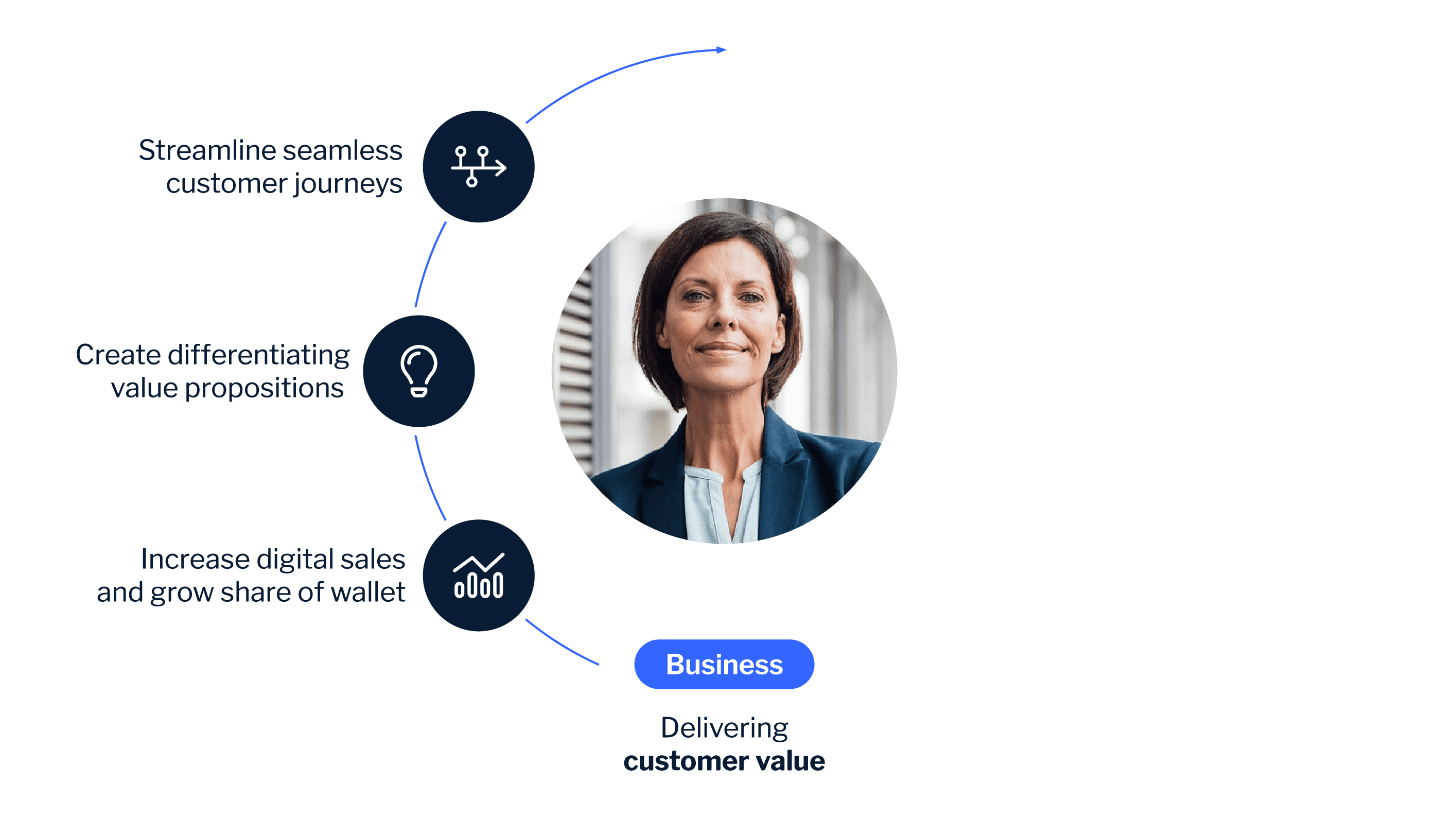
Using your flywheel to drive customer value begins with streamlining your fragmented customer journeys — the biggest point of friction out there. Rather than pouring money into keeping legacy systems alive, get brutally focused on making these journeys as seamless as possible. Pull that off and you'll free up funds for differentiation, increase digital sales, and grow your share of wallet — eventually creating a winning formula that self-finances, as the chart below shows.
How can I harmonize my bank's flywheel to enable continuous innovation?
Harmonizing both sides of your flywheel creates a self-reinforcing cycle that accelerates growth in ways that are impossible in isolation. Here's how it works:
- Simplify your tech infrastructure using a unified platform model — cost savings and agility follow immediately
- Reallocate those savings toward streamlining your customer journeys, generating both business and customer value
- Capitalize on new revenue through cross- and up-sell opportunities as your customer experience improves
- Reinvest back into tech and repeat the cycle — each loop compounds the last
See the chart below for a visual breakdown of how it all comes together.
![[Blog]-[Featured-image 2]-[What is a banking flywheel]-[EN]](https://cdn.prod.website-files.com/6899ede6858421789bbab873/689c9140d2669981b4184cbf_image.png)
Part 3: progressive modernization
What is modernization in banking?
Modernization in banking refers to the ways through which your bank updates and improves its existing systems, infrastructure, and processes, allowing you to enhance operational efficiency and reduce costs. It's more tech-focused than a digital transformation, but no less important. With legacy systems in place, it's all but impossible to compete in a crowded market, let alone deliver real customer value — and banks are lagging behind other industries on this front.
Did you know that
the average age of bank IT applications is among the highest across industries at an estimated 14 years, compared to 4.5 years for retailers, according to McKinsey.
How are banks modernizing their core banking systems?
The days of monolithic, siloed core banking systems are over. Banks are increasingly hollowing out their cores, shifting to modern, cloud-based platforms managed by third-party vendors. But even with modern advances, key challenges remain:
- Integration complexity: multiple code bases and stacked point solutions built up over years
- Stability vs. innovation: the constant pressure to keep systems secure and compliant while still moving fast
A unified platform model has emerged as the go-to solution — proven to generate ongoing value and decompose your bank's complexity at the same time.
What are the top 3 approaches for modernizing my bank?
Like McKinsey, we see three clear paths to banking modernization:
- Big bang replacement — overhauling the user interface, core systems, and integrations all at the same time with a monolithic system update.
- Greenfield approach — reusing elements from your existing infrastructure to quickly create a cloud-native tech stack.
- Progressive modernization — leveraging incremental, iterative improvements to modernize your most important customer journeys and underlying processes.
Our recommendation is progressive modernization, the middle-of-the-pack option that gives you medium speed and cost, but at significantly lower risk. Unlike the other approaches, a progressive modernization is suitable for almost every bank.
What is progressive modernization in banking?
Progressive modernization in banking involves four key steps:
- Assess your needs — evaluating your existing systems, processes and tech while taking care to solicit feedback from customers and employees
- Strategize a way forward — defining clear objectives, isolating burning issues in an agile, cross-functional team, and creating a modernization roadmap that includes a true strategic partner
- Implement your strategy — modernizing on a journey-by-journey basis, prioritizing high-impact, customer-facing areas that will immediately demonstrate value
- Repeat the process — using your newly created digital factory to start over, preferably by adopting open banking standards and an industry-specific integration platform-as-a-service (IPaaS).
Once you're done, don't forget to continuously monitor and improve your new tech and systems, assessing them against predefined metrics and KPIs.
What are the three key approaches for performing a progressive banking modernization?
Once you've selected a progressive modernization, you'll need to choose between three key approaches:
- Segment-based — starting at the business segment level, typically on the onboarding or servicing side of things, and replacing existing apps/services
- Journey-based — selecting a single journey to modernize, front-to-back, beginning with the ones that are in need of an overhaul and have a positive ROI or cost impact.
- Headless — rewiring your core systems and adopting a digital banking platform that will power your different channel applications, allowing you to reduce logic duplication across your tech stack.
How you choose will depend on your bank's needs, size, and resources — so consider these carefully before you begin.
Taking the first step
You now have the foundation. Here's where to go next:
- Banking Reinvented podcast: weekly conversations with Backbase leadership and bank executives on modernization trends
- Step-by-step modernization guide: written by Backbase Founder/CEO Jouk Pleiter — a practical blueprint for progressive banking modernization
- Talk to our experts: ready to get started? We'll help you build a modernization plan that actually works.