Adoption is ahead of the discipline to measure it
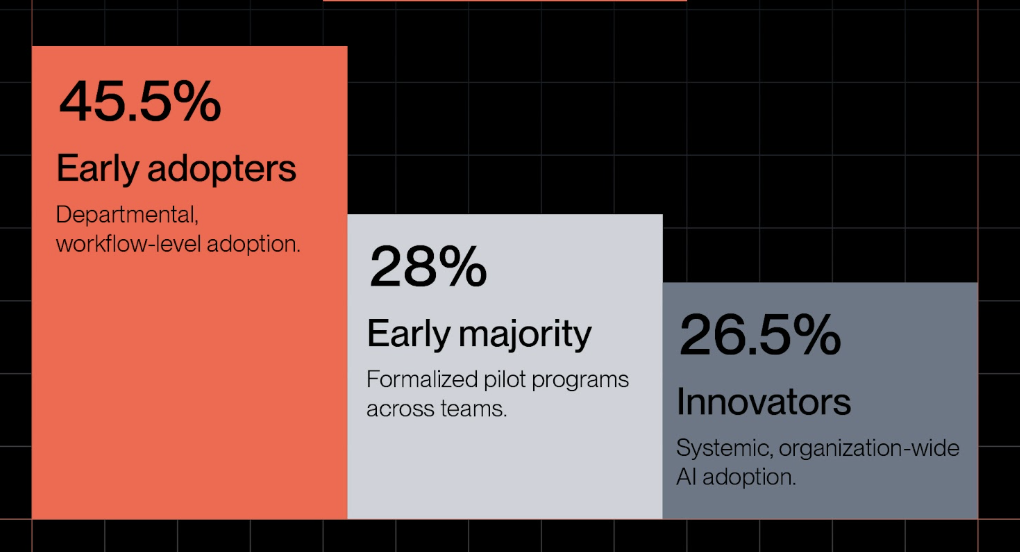
Sentiment is strong, with 86.9% of respondents positive about AI's role over the next two years and 83.2% expecting to increase investment. Banks split into three tiers: 45.5% are Early Adopters running AI at the department level, 28% are Early Majority piloting across teams, and 26.5% qualify as Innovators running AI at a systemic, organization-wide level.
Governance tracks maturity closely: 44.1% of Innovators report board-level involvement in AI strategy, compared with 25.6% of Early Adopters. Only 7.4% of Innovators report having no governance protocols at all, against 39.3% of Early Adopters. Governance behaves less like a brake on adoption and more like a signal of it.
Where AI is producing measurable results
Conversational AI is the universal entry point, deployed by roughly half of respondents regardless of maturity tier. The use case executives rate most impactful, however, is fraud detection and transaction monitoring, followed by credit scoring, particularly alternative credit assessment for thin-file customers who lack a formal credit history. The World Bank's Global Findex Database 2025 puts account ownership in Sub-Saharan Africa at 58%, leaving 42% of adults unbanked. AI-driven credit scoring is one of the more credible paths to bringing that population into the formal system at a cost banks can sustain, a theme that also runs through why SME banking is Africa's next growth story.
Deployment also delivers operational impact beyond credit. Nedbank's use of Kasisto's KAI platform cut live-agent chat volume by more than half within 12 months of launch, freeing frontline staff for the complex cases that still need a person. Innovators differentiate through breadth: they deploy advanced financial services and credit scoring at rates 24 and 16 percentage points higher than Early Adopters, respectively.
Is the return actually there?
Among the 277 banks surveyed, 67.1% measure AI ROI in some form. Of those, 85.1% report results that meet or exceed their original projections. The return is documented for the banks that look for it. What's unresolved is whether it exists, unmeasured, for the third that don't.
Who tracks ROI, and who doesn't
The executives making AI investment decisions are the least likely to track whether those investments work. C-suite leaders measure AI ROI at half the rate of Finance teams, 50% against 82%, despite Finance carrying direct profit-and-loss accountability. Risk and Compliance functions show the second-highest non-measurement rate, at 48.1%, despite being primary implementers of AI controls.
Institution type cuts against expectation. Pan-African banks, often the most sophisticated operators on the continent, measure ROI at the lowest rate of any group, 54.2%, while regional banks measure it at 90.9%. Multi-jurisdictional scale appears to work against visibility rather than for it.

Legacy integration: the barrier that blocks both adoption and measurement
Legacy system integration tops every barrier list in the survey, cited by 50.2% of respondents internally and 50.0% industry-wide. It is also the reason many banks cannot measure what they have already deployed: 57.9% of non-measurers name legacy integration as their greatest challenge, against 45.8% of banks that do measure ROI. The same constraint causes the problem and obscures the evidence of it.
A confidence gap sits underneath that figure. 48.5% of respondents rate their legacy systems as highly or fully capable of supporting AI, even as legacy integration remains the most-cited obstacle to making AI work. Africa's banks don't have an AI problem. They have an architecture problem.
What this means for banking leaders
African banks already outperform on paper. Average return on equity reached 19% in 2024 and held at 17% in 2025, against a global average near 10%, according to McKinsey's most recent snapshot of African banking. But cost-to-asset ratios run roughly double the global average, which narrows the margin for error on technology spending. A European bank that over-invests in a fragmented AI rollout absorbs the cost as a write-down. An African bank operating on a 2.6% cost-to-asset ratio, dollar-denominated infrastructure bills, and a tightening data-localisation timetable absorbs the same mistake as a capital event.
Autonomous agents raise the stakes further, because they don't tolerate fragmentation the way a human employee does. An agent acting across systems needs the core and the CRM to agree on a customer's status before it can act on either. When they disagree, the result surfaces as a compliance failure rather than a technical bug. That is the case for treating unified architecture as agentic banking's prerequisite rather than an afterthought, a point explored further in Banking Reinvented's conversation on why Africa won't miss the AI revolution. Institutions that fix the foundation while deployments are still young will spend less and comply more easily than those layering another decade of point solutions on top of what they already run.
Questions banking leaders are asking
- What share of African banks measure AI ROI?
Among the 277 banks surveyed, 67.1% measure AI ROI in some form. Of those, 85.1% report results meeting or exceeding their original projections. - What is the biggest barrier to AI adoption in African banking?
Legacy system integration, cited by 50.2% of respondents as their top internal obstacle and 50.0% as the top industry-wide constraint. It also correlates with weaker ROI measurement across the sector. - Do banks that partner with AI vendors see better returns than banks that build in-house?
Yes. Institutions working with third-party AI frameworks measure ROI at more than twice the rate of those building entirely in-house, 71.7% against 31%. - Is AI actually worth the investment for African banks?
Among banks with formal ROI measurement in place, 85.1% report meeting or exceeding their targets. The open question isn't whether AI pays off. It's whether a bank has the architecture and discipline to know.