AI budgets across the banking industry are growing, but so is the scrutiny over what those budgets produce. CFOs are increasingly stepping into AI oversight with the same rigor they bring to capital expenditures, expecting every initiative to deliver a clear return. Meanwhile, commercial banking teams find themselves pressured to adopt new technology while running complex operations on aging infrastructure.
Where is AI in commercial banking actually delivering results in the middle of all of this?
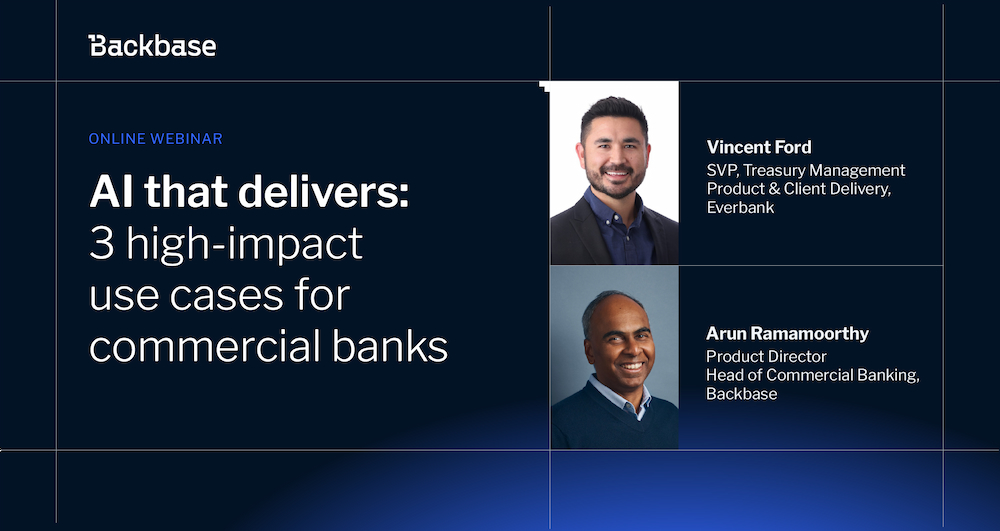
In a dedicated webinar, Arun Ramamoorthy, Head of Commercial Banking at Backbase, and Vincent Ford, SVP of Treasury Management Product & Client Delivery at EverBank explored three use cases where AI is making a measurable difference today: commercial onboarding, relationship manager productivity, and client-facing liquidity tools.
A practical distinction ran through the entire conversation: automation versus augmentation. Automation removes manual, repetitive work, like parsing compliance documents or routing payments. Augmentation makes bank employees smarter at their jobs, like surfacing cross-sell opportunities for an RM or predicting a client's cash flow shortfall before it hits.
The best commercial banking AI applications do one or both.
We summarize below the main takeaways from the webinar for commercial banking leaders. For a vendor comparison focused on lending, onboarding, and commercial banking scope, see Backbase vs nCino for commercial banking. For the broad category overview, see AI in commercial banking. For the leadership and deployment decisions behind these use cases, see commercial banking AI strategy and how banks move AI from pilot to governed production.
Use case 1: AI-powered commercial onboarding
Commercial onboarding goes well beyond opening an account and issuing a login. It involves navigating compliance requirements, reviewing complex corporate structures, and integrating clients across multiple back-office systems. All of this makes it one of the most time-consuming processes in commercial banking.
The cost reflects that complexity. Industry estimates put the KYB & KYC review burden at roughly $175 million for large institutions, mainly because the process remains manual and paper-heavy across most banks.
"It takes three to four hours to look at the articles of incorporation of a company to determine how they're structured. An agent could review it and give you that information in seconds."
— Arun Ramamoorthy, Head of Commercial Banking, Backbase
The challenge extends well beyond document review. "Our clients range from small businesses all the way up to large mega corporations, and each one has a different business model and a different flow of funds. Being able to reduce the time to get to know our clients - and set them up for success from day one - is huge," explained Everbank's Vincent Ford.
AI can accelerate commercial onboarding in three specific areas:
- Document intelligence: Agents parse articles of incorporation, ownership structures, and compliance documents - pulling key data in seconds instead of hours.
- Guided setup: Machine learning models walk clients through entitlements, templates, and authorization controls based on their specific business profile.
- Migration support: Intelligent transfer of payee data, payment templates, and configurations from a client's previous bank, which removes one of the biggest friction points when commercial clients switch institutions.
Industry research estimates AI can drive up to 60% efficiency gains in the commercial onboarding process. For commercial banks that handle hundreds of complex client setups per year, that improvement represents a fundamental shift in how new business comes through the door.
Continue reading: Automating KYB and entitlements in commercial bank onboarding
Use case 2: AI for relationship manager productivity
According to McKinsey, commercial banking RMs spend just 25 to 30% of their time in actual client dialogue - far below RMs at top-quartile institutions. The rest disappears into pulling reports across systems, compiling data for meetings, and responding to routine queries by email. Highest-value people in a bank are consistently doing low-value work.
Ford sees this as a data problem at its core:
"You can't make decisions if you don't have the right data structures in place. A report is only as good as a report - it's an Excel spreadsheet you can't do anything with. You need something actionable."
— Vincent Ford, SVP Treasury Management Product & Client Delivery, EverBank
AI-powered "next-best-action" engines address this by sitting across your CRM, transaction data, and product hierarchy, then surfacing specific opportunities for each client at the right moment. Signals include a client trending toward net borrowing, a commercial account with high card-eligible vendor spend, or a deposit pattern that signals a need for new treasury products. Instead of the RM spending hours assembling that picture manually, the intelligence comes to them - ready to act on.
McKinsey estimates that agentic AI could return 10 to 12 hours per week to each banker and improve client coverage ratios by roughly 40%. That's the difference between an RM who's reactive and one who's actually growing the relationship.
Use case 3: Predictive cash flow and treasury management AI
Commercial clients are questioning what their banks actually add beyond holding deposits and issuing loans. Fintechs now offer sharper cash management, faster payments, and cleaner financial operations - and the commercial client pool is paying attention. Banks that can't match that on their own turf will watch the relationship erode, one service at a time.
That competitive pressure is real, but banks hold a significant advantage. As Ford put it: "As a bank, we're regulated and trusted. We're going to make sure you're safe. There's a lot of rigor we go through to build tools for our clients."
The question is whether banks can pair that trust with the kind of intelligent tooling that clients are increasingly expecting. Two AI applications help banks achieve this balance:
Intelligent payment routing. Companies send payments through multiple channels, such as card, ACH, wire, and check. Each channel carries different costs, speeds, and risk profiles. Most commercial clients don't have a clear way to evaluate which method works best for each transaction, especially when vendor acceptance and revenue-sharing terms vary across their payee base.
AI can analyze these variables and recommend the optimal payment channel automatically, saving the client time and money on every payment cycle while giving them confidence that each payment is routed through the safest, most cost-effective path available.
Predictive cash flow. Commercial clients range from small businesses running basic accounting software to large corporates with full financial teams managing enterprise ERPs. And each one of them needs visibility into what's coming.
AI models can map inflows and outflows, forecast liquidity patterns, and flag potential shortfalls before they become problems. This gives financial teams the lead time to act rather than react. Ford shared a practical example from his own work with data models: "Models that used to take me weeks to put together can take me an hour. I can throw it into a Power BI tool and it produces dashboards with actual actionable items."
Fintechs are building fast in this space, but they're still earning the regulatory trust that banks already carry. AI gives banks the ability to match that speed without compromising on the rigor their clients depend on.
These tools reposition the bank as a financial advisor to its commercial clients, actively helping them make better decisions about how they move and manage money.
Consolidate value-added services for your commerical client on a unified platform with Backbase
Key takeaways for commercial banking leaders
Augment, don't replace. AI works best when it gives your people better tools, not when it tries to replace them. As Ford put it: "AI is not magic. It's an augmentation function."
Start with your data. AI models are only as good as their inputs. Clean, well-structured data across your CRM, transaction systems, and product hierarchies is the foundation that everything else builds on.
Pick specific use cases. Focus on high-friction processes like onboarding, RM workflows, and client-facing liquidity tools where the ROI is clear and measurable. AI doesn't have to be fancy; it has to solve real world problems.
Build governance early. In a poll during the webinar, 76% of banks cited compliance as their top concern. Establishing AI governance policies gives teams the confidence and the framework to move forward.
Bring your people along. The best tools are worthless if your teams won't use them. Sell the value, not the hype and let results build buy-in.
How Backbase helps
Backbase's Banking OS gives commercial banks one execution surface across every channel - self-service, assisted, and Conversational Banking - so RMs spend less time on admin and more time on relationships, and onboarding moves at the speed clients actually expect.
Want to see these use cases in action? Watch the full webinar recording.
For the fuller picture, see our complete guide to AI in commercial banking.
Frequently asked questions about AI in commercial banking
What are the most impactful AI use cases in commercial banking right now?
Three use cases are delivering measurable results today. First, AI-powered document intelligence in commercial onboarding - parsing articles of incorporation, ownership structures, and compliance documents in seconds instead of hours. Second, next-best-action engines that surface cross-sell opportunities and relationship signals for RMs without manual data assembly. Third, predictive cash flow tools that forecast liquidity patterns and flag shortfalls before they become problems for commercial clients.
What is the first step for commercial banks looking to deploy AI?
Start with a single high-friction process where the ROI is clear and measurable - commercial onboarding, RM workflow automation, or client-facing liquidity tools are the highest-value starting points. Clean, well-structured data across CRM, transaction systems, and product hierarchies is the foundation. Establish AI governance policies early - in a recent poll, 76% of banks cited compliance as their top concern when deploying AI.