
As financial institutions face increasing competition, regulatory complexity, and shifting customer expectations, one of the biggest challenges remains onboarding and origination. These processes, which should be fast and efficient, are often bogged down by fragmented systems, manual workflows, and a lack of standardization.
According to Deloitte, the onboarding process for commercial clients can take over 16 weeks, with banks investing as much as $20,000 to $30,000 per client.
As competition grows and regulatory requirements become more stringent, outdated onboarding processes lead to skyrocketing operational costs, lost revenue opportunities, and a frustrating customer experience. And in a world where clients expect seamless, digital-first solutions, delays can push them toward fintechs and alternative providers who offer more flexible services.
Addressing these pain points is no longer optional — it's essential for banks to remain competitive in today's market. In this article, we'll explore why these processes are so challenging, the risks of outdated systems, and how digital transformation can help banks streamline operations and improve customer satisfaction. Let's dive in.
Why is onboarding and origination so challenging in commercial banking?
Commercial banking onboarding and origination face four critical challenges: fragmented legacy systems, manual paper-based workflows, regulatory complexity, and siloed departmental processes. These factors combine to create 16-week onboarding cycles that cost banks $20,000-$30,000 per client. Here's how each challenge creates operational bottlenecks and revenue loss.
1. Delayed access to banking services
Commercial banking onboarding is complex, tailored to each business's unique needs. As such, delays in enabling key services become a huge challenge in the onboarding process.
The sheer volume of documentation and approvals, often requiring the input of multiple stakeholders, extends the process to weeks or even months, making it difficult for clients to access banking services as quickly as they would like to.
Complex commercial loans face even greater origination challenges. Extensive underwriting, pricing assessments, and multiple approval rounds stretch timelines to weeks. Current bank systems cannot overcome these delays.
2. Manual processes and paper-based workflows
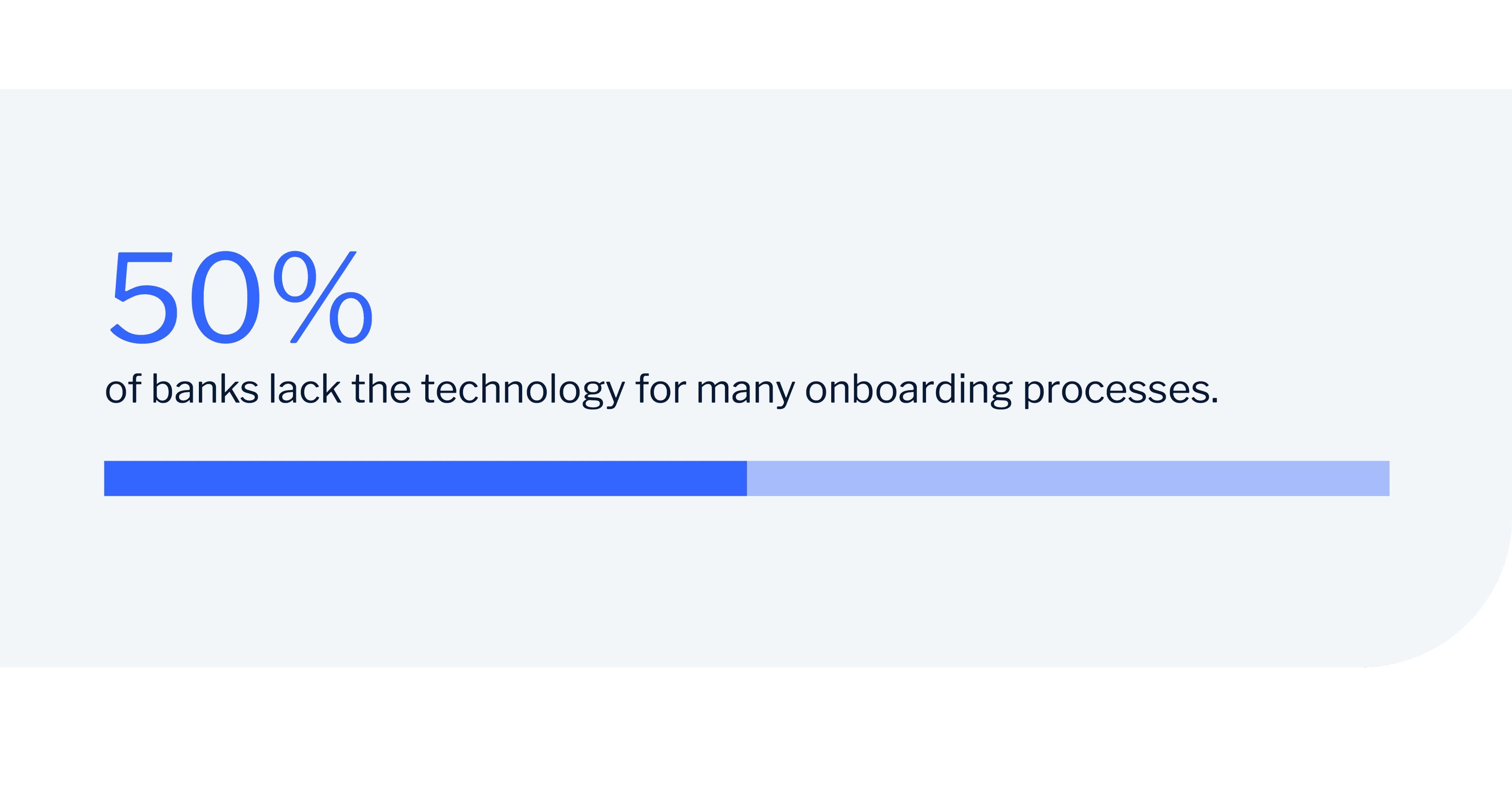
Many banks still rely on paper-based documentation and manual data entry, increasing processing times and error rates; research from McKinsey has shown that as much as 50% of banks don't have the tech for many of the onboarding processes. And with a process as complex as the one commercial clients go through, the back-and-forth required for banking onboarding and origination leads to frustration and lost opportunities.
3. Siloed systems and fragmented workflows
System fragmentation creates these specific client pain points:
This fragmented approach makes account setup and loan approvals unnecessarily complex.
Instead of a streamlined process, banks rely on legacy infrastructure that lacks integration, slowing down approvals and increasing costs.
4. Regulatory and compliance hurdles
Banks must adhere to strict KYB and AML regulations, but many still use time-consuming compliance processes that require businesses to repeatedly submit the same documentation across multiple departments. In fact, 48% of financial institutions identified insufficient or outdated AML compliance technology as a major challenge. This redundancy prolongs the already lengthy onboarding approvals for commercial clients.
Manual compliance checks create blind spots that expose banks to fraud and regulatory penalties.
How can banks speed up compliance without compromising accuracy?
Modernizing KYC and AML with automation and data-driven risk assessment delivers both speed and accuracy, unlike rushed manual processes.
The business impact of inefficient commercial banking onboarding
The consequences of inefficient onboarding extend beyond customer frustration — it's costing banks revenue, market share, and operational efficiency. Here's what's at stake:
How much does inefficient onboarding cost banks?
Inefficient onboarding costs banks $20,000-$30,000 per commercial client and extends timelines to 16 weeks, resulting in lost deals and operational drain.

The fast track to smarter onboarding: How banks can win with a digital-first approach
Addressing these challenges requires a shift towards a digital-first, platform-based approach. Commercial onboarding is one part of wider commercial banking modernization, which also includes treasury, lending, trade, and relationship management. Here's how banks can modernize their onboarding processes:
1. Deliver an omnichannel experience
Unified platform integration: A single system handles payments, lending, and treasury management under one omnichannel experience layer.
This approach ensures CFOs and treasury teams can seamlessly onboard across all banking services without system switching.
Instead of requiring customers to submit the same information multiple times, the system reuses data across services and channels, eliminating redundancy and accelerating approvals. The result is enhanced satisfaction for clients and more effective cross-selling and upselling for financial institutions.
2. Automate and streamline processes
Manual processes create bottlenecks. By leveraging AI-driven document verification, KYC automation, and real-time decisioning, banks can accelerate onboarding while reducing manual effort. Automated document scanning and applications can reduce manual handling and improve workflow visibility.
3. Enable personalized journeys at scale
A platform approach makes it possible to configure banking onboarding journeys based on both customer archetypes and the specific products and services.
Smart data reuse: Banks pre-fill forms using existing client data, requiring only validation instead of complete re-entry.
This streamlines onboarding for both small businesses and multinational corporations setting up complex treasury services.
4. Implement a connected ecosystem for seamless integration
Legacy systems often make it difficult to integrate new solutions, leading to siloed data and redundant processes. Open APIs solve this challenge by enabling a more connected ecosystem where data flows efficiently across departments and integrates with a commercial client's existing systems, such as accounting or ERP platforms.
This means, for example, that instead of requiring businesses to manually submit multiple financial reports for a loan application, banks can automatically pull in the necessary data, accelerating approvals and reducing friction in the onboarding process.
5. Enhance self-service capabilities
Digital banking platforms empower clients to complete portions of the onboarding process themselves. Whether it's submitting documents, tracking application status, or configuring account settings, self-service capabilities can significantly reduce onboarding time and free up bank staff for more strategic tasks.
Beyond efficiency, self-service tools improve transparency by giving clients a clear view of where they are in the process and what steps remain. Instead of waiting for updates, they can check their application status in real time.
A single digital platform also facilitates collaboration between clients and bank employees. For example, if a banker needs more information to underwrite a loan, they can send a request directly through the platform. The client then receives an SMS notification and can quickly upload the required documents, eliminating back-and-forth emails and scattered paperwork.
How much can self-service reduce onboarding time?
Self-service capabilities can cut onboarding time from weeks to days by eliminating manual document handling and providing real-time status transparency.
Commercial loan origination: from application to approval
Commercial loan origination connects application intake, financial spreading, document review, credit decisioning, and approval routing. Each step can involve different teams and systems.
A connected workflow gives lending teams one view of the application, required evidence, outstanding decisions, and approval status. Relationship managers can then track progress without reconstructing the case manually.
This process belongs inside the wider commercial onboarding and origination solution area. It should connect the client interface with the operational work behind credit approval.
The operational work behind onboarding and origination belongs to Customer Operations, including evidence collection, exception routing, and approval coordination.
Faster onboarding means stronger relationships
As commercial banking continues to evolve, institutions that prioritize a digital-first strategy will have a significant advantage. Banks that fail to modernize their onboarding and origination processes risk falling behind as non-bank competitors and fintechs offer faster, more flexible solutions.
A shift toward composable banking solutions enables banks to build scalable, adaptable platforms that cater to the specific needs of their commercial clients. Moving away from legacy, monolithic systems to modular, API-driven platforms enhanced by AI-powered automation will be crucial in ensuring speed, efficiency, and personalization in onboarding and origination.
At Backbase, we believe that the future of commercial banking is about more than just digitizing legacy processes — it's about rethinking how banks engage, onboard, and serve their commercial clients. A unified platform approach is the key to making that transformation a reality.
Learn more about how Backbase can streamline commercial banking processes.