Summary
- Digital dead ends now drive 38% of negative US bank reviews, rising even as hold-time complaints fall.
- Each failed self-service interaction can wipe out expected savings, spike support costs by 734%, and trigger attrition among once loyal customers.
- Default metrics count abandoned sessions and offline redirects as wins; banks must shift to Task Completion Rate (TCR) to measure real resolution.
- Banks need assistants connected to core systems that know the customer, execute transactions end to end, and hand off with full context when policies require it.
The case for automated chat servicing is obvious. Across industries, Gartner puts the median cost of a self-service contact at $1.84, compared to $13.50 for a human-assisted channel. That’s a savings of 86%.
In response, banks have deployed bots at an unprecedented scale. In 2025, bots served more than 1.8 billion consumers worldwide, handling more than 3.1 billion interactions a month. Chatbots are now the first interaction in the app, voice bots answer the phone, and automated verification runs across every channel.
But what happens when digital interactions fail and no human steps in to help? These are digital dead ends, and they’re where savings unravel and complaints pile up. In Capgemini’s 2024 global survey, 61% of bank customers said they call an agent when a chatbot fails to resolve their issue.
When that happens, banks aren’t deflecting costs; they’re compounding them. The bank pays for the failed interaction, the frustrated call that follows, and the lasting damage to the relationship.
“A bank I’ve been with for over 40 years. I’m trying to reach someone regarding account security, and their automated system does everything possible not to connect you to a human.”
– Trustpilot review, Tier 1 US bank
Customers like this one are making their voices heard. Backbase analyzed 6,400 Trustpilot reviews across 100 large US banks, revealing an emerging trend: as customer service bots spread across the industry between 2023 and early 2026, the share of 1-star reviews climbed by 14%. While hold-time complaints fell, "digital dead ends" became the top frustration, surging to 38%.
These dead ends within traditional banks are especially damaging given the stark contrast in customer experience with digital-native competitors. Just nine out of 2,672 reviews praised the digital experience at traditional banks. At digital-native banks, the app is what customers praised most.
And long-time loyalists like that 40-year customer aren't alone in their breaking point. Nearly 1 in 15 negative reviews say they plan to end their banking relationship of 15 to 40 years or more. That’s the real cost of deflection. The call queue might get shorter, but the bank’s longest-standing customers are walking out the door.
What does a digital dead end cost a bank?
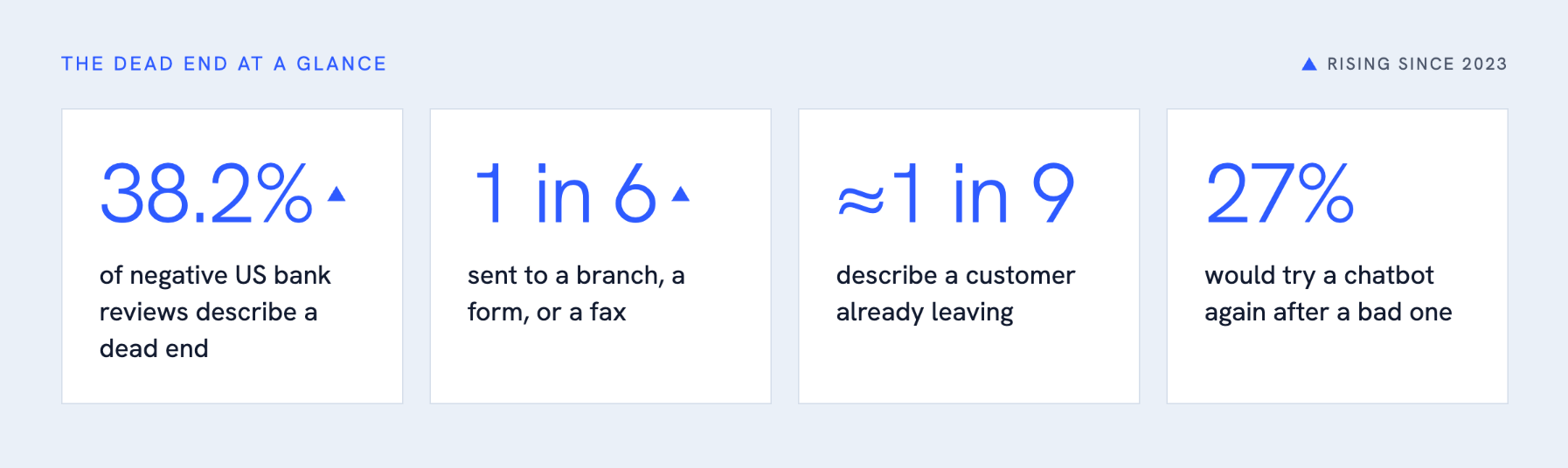
A digital dead end can wipe out the entire 86% savings a bot was meant to deliver. Here are six ways one failed interaction adds up:
- The bank pays twice. When the bot fails to resolve the request, the customer calls a customer service agent. That original $1.84 interaction balloons to $15.34, a 734% increase. Worse, the customer service agent now has to start the call with a customer who is already frustrated.
- The savings don’t return. Only 27% of customers will try a bot again after a bad experience, according to Gartner. The rest go back to traditional channels, taking the planned savings with them.
- The complaint goes public. Customers don’t keep bad experiences to themselves. They tell friends and family, post in forums, and leave public reviews. AI-powered search now aggregates that sentiment, surfacing it when prospective customers ask about your bank.
- Loyal customers leave. Roughly 1 in 9 negative reviews comes from a customer fed up enough to leave. Many have banked there for decades.
- New customers cost more. Every customer who leaves has to be replaced. The bank pays to win someone new, just as mounting negative reviews make that harder and more expensive.
- Regulators get involved. In 15.8% of negative reviews, customers mention a regulator, a lawsuit, or a watchdog. In 2023, the CFPB stated that chatbots must meet the same consumer financial laws as human agents. When a customer follows through, a $1.84 conversation becomes a compliance issue carrying heavy fines.
“Banked with them for over 25 years and now, just want to close the account and leave.”
– Trustpilot review, Tier 1 US bank
These costs are hard to quantify, but your bank can put its own numbers on them: the lifetime value of a loyal customer, the extra time an agent spends with a frustrated caller, and the cost of a regulatory inquiry. A bot might have deflected one call. Losing a customer of 25 years saves nothing.
What are the most common digital dead ends in banking?
Each dead end starts in a self-service channel meant to cost $1.84 and ends somewhere far more expensive. These dead ends can be grouped into three points in the customer’s journey: logging in, connecting to support, and reaching a resolution.
Failed logins and access
| Dead end | Evidence | The fix |
|---|---|---|
| App and login failures | 36.4% of negative reviews | Authentication handled inside the conversation, with a guided way back in. |
| Identity verification that keeps failing | “Nonstop glitches in the verification.” | Verification that draws on what the bank already knows, with a fallback to a person. |
| Account locked after normal activity | “My account has been locked for security purposes for months.” | Real-time policy checks that tell routine activity from risk, with a fast path to unlock. |
Failed routing and support
| Dead end | Evidence | The fix |
|---|---|---|
| No way to reach a person | 3% of negative reviews | A clear, visible path to a person, with the full conversation attached. |
| Stuck in the phone system | “I keep getting stuck in their automated phone system.” | Context that carries across voice and chat, with a handoff to a person when the bot can’t help. |
| Sent to an FAQ page | [Add a review quote or stat] | An assistant that understands intent and acts on it, with no detour to a policy page. |
| Callback promised but never made | “The call never came.” | An automated handoff to an agent with full context, in the same conversation. |
Failed resolution
| Dead end | Evidence | The fix |
|---|---|---|
| Told to visit a branch, mail a form, or send a fax | 16.7% of negative reviews | Read and write access to core systems, so the request is completed in the conversation. |
| Payment delayed | 15.3% of negative reviews | Real-time access to payment status, so the assistant can say where the money is. |
| Account frozen or closed without warning | 4% of complaint excerpts (109 of 2,672) | Policy-governed actions that explain what happened and route the case to a person. |
| Estate and bereavement cases stalled | 2% of negative reviews | Documents submitted and tracked inside the conversation. |
Is the bot the real problem?
No, it’s not, but the underlying architecture is. Just 2.4% of negative US bank reviews in 2025 to 2026 explicitly blame AI, a bot, or an automated system, while 38% describe a dead end.
Regardless, customers hold the bank responsible, and they're right to.
Most banking chatbots are built as shallow conversational wrappers or siloed software that sit on top of existing core banking technology. They operate strictly as search engines for text files. They can read text and provide information from a library of help articles, but they have zero integration with core transactional systems and no ability to take action.
This disconnected architecture creates a series of immediate operational failures:
- Zero identity awareness: The bot doesn't know who the customer is or their prior attempts to resolve the problem.
- Forced customer repetition: Customers are forced to repeat everything to the bot, and then again to a customer service agent.
- Systemic paralysis: Bots cannot access the fraud models, routing rules, or core systems required to actually execute a task.
Because of this, a simple request like updating an address or disputing a charge stops at the edge of the chat. That is a structural gap, and no single team caused it.
When dead ends become the norm, customers learn to bypass the bot entirely. Deloitte found that 74% of US banking customers prefer a human even for simple, routine queries.
A brilliant language model trapped in a disconnected architecture will still result in an expensive digital dead end. Until automated systems can actually issue refunds, unfreeze cards, or clear false fraud alerts, customers will keep demanding human agents, erasing the ROI banks expected from deflection.
The pivot: From bots to agentic servicing
This is the critical distinction between a traditional bot and agentic servicing:
- A bot runs on a script. It deflects interactions but rarely resolves the underlying issue.
- An AI agent draws on shared context. It taps into the bank's entire ecosystem to understand intent, then takes governed action to either fully resolve the request or seamlessly escalate it to a person.
How should a bank measure bot success and ROI?
When it comes to bots, banks commonly celebrate high containment rates, or the percentage of chat interactions that did not reach a human agent. However, high containment rates often hide systemic failures, rewarding bots that send customers in frustrating circular “doom loops” until they simply give up and close the window.
To measure real ROI, banks must pivot to outcome-based metrics. Task Completion Rate (TCR) is the share of customers who finish what they started.
On a containment dashboard, the past three years look like progress. Hold-time complaints fell from 15.3% to 11.3%, yet digital dead ends rose from 33.9% to 38.2%. The queue got shorter because fewer customers reached it. Their problems didn’t go away.
Across industries, Gartner found that only 14% of service issues are fully resolved in self-service. Much of what containment classifies as a success is actually a customer who gave up, went offline, or called anyway.
Containment rate vs. task completion rate
| Containment rate | Task completion rate | |
|---|---|---|
| What it counts | Chats that never reached an agent | Requests the customer finished |
| A customer sent to a branch | Recorded as a success | Recorded as a failure |
| KPI rises when | Customers give up or get stuck | The assistant resolves the request |
TCR counts completed requests, such as an updated address, a filed dispute, or a replaced card. With AI spending up 38% while service budgets grew only 2%, according to Gartner, leadership should demand undeniable proof that their AI investments are working. TCR is that proof.
How Backbase replaces dead ends with completed requests
Backbase Conversational Banking delivers end-to-end agentic servicing to financial services firms. It natively understands customer intent, interacts safely with your core ledgers, and orchestrates seamless human handoffs, acting within your bank’s strict operational rules.
Because it operates as an AI-native Banking OS layered on top of your existing architecture, eliminating digital dead ends doesn't require a multi-year core replacement.
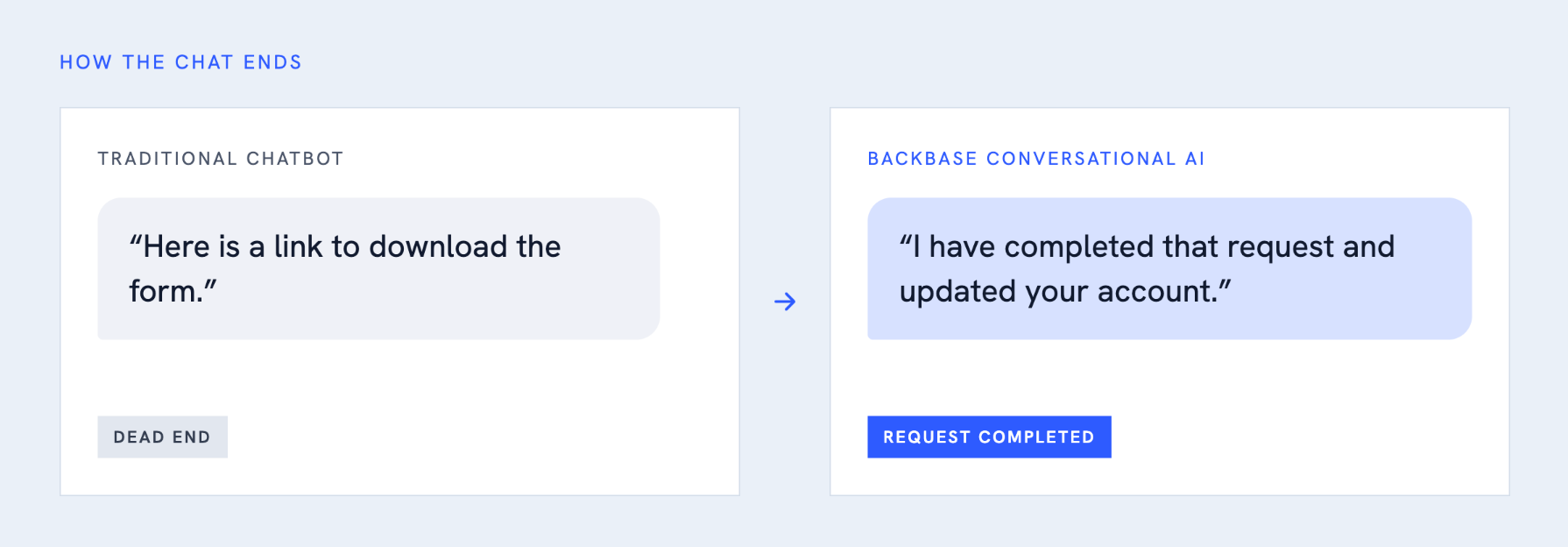
Three foundational capabilities transform existing customer friction into seamless resolutions:
- It knows the customer. Deep context is preserved across every channel and handoff. Customers never have to repeat their issue to a digital assistant, and they never have to repeat it again to a human specialist. This cross-channel continuity directly impacts profitability as 62% of contact center agents report weak bots hurt their productivity.
- It is authorized to act. Traditional chatbots can only read and display information, like displaying a checking balance. Backbase enables governed read-and-write execution directly into core transactional systems. The agent doesn't send a link to a form. It updates the address or files the dispute right inside the conversation stream.
- It knows when to hand off to a human. Every action is evaluated against bank-defined validation policies, entitlement boundaries, and regulatory rules in real time. If a request involves a complex exception or a high-risk transaction pattern, it triggers an instant, warm handoff to a human employee, passing the complete conversation audit trail natively into the Customer Operations Workspace.
All three capabilities operate on a single Unified Frontline, an integrated ecosystem where customers, employees, and AI agents collaborate within a single operational environment. Every resolved request is a customer that never escalates to your contact center, a negative public discourse, or a regulator.
So at your next operational review, ignore vanity metrics like "containment rates." Ask your teams one single question: How many customers actually finished what they started?
Frequently asked questions
What is a digital banking dead end?
A digital dead end occurs when a customer using a self-service channel, like a chatbot, gets stuck and is forced to call an agent, visit a branch, or abandon their request entirely. An analysis of 6,400 Trustpilot reviews found digital dead ends mentioned in 38.2% of negative bank reviews from 2025 to 2026.
What is the ROI of an AI chatbot in banking?
AI chatbot ROI comes from the requests a bot actually resolves, not the volume it deflects. A self-service contact costs a median $1.84 compared to $13.50 for a human-assisted channel, but when the bot fails and the customer calls anyway, that contact costs $15.34. Banks see a real return when the assistant connects to core systems, completes tasks end to end, and is measured on Task Completion Rate rather than containment.
How do failed chatbot interactions cost banks money?
Failed bot interactions erode AI chatbot ROI by forcing customers to switch to expensive live agents, causing long-time loyalists to close their accounts, and potentially triggering costly regulatory inquiries.
How should banks measure conversational AI success?
Banks should measure success using Task Completion Rate (TCR) to track the percentage of customers who actually finish their requests, rather than relying on containment rates that falsely count abandoned chats as wins.
What is the difference between a bot and conversational AI in banking?
A traditional bot relies on static scripts and can only read information, whereas conversational AI integrates directly with core banking systems to take governed actions and fully resolve complex customer requests.
How quickly can a bank deploy agentic conversational AI?
In less than three months. Backbase's 90-day launch plan bypasses endless pilot traps, putting a fully integrated conversational AI into live, controlled production in just 90 days.