Engineering standards first
"AI amplifies existing engineering habits, good and bad, at machine speed," Schroder says. If a team already writes tests, reviews code properly and has standards people actually follow, AI helps them go faster and the system catches whatever slips through. If they don't, they just get more of the same problems, produced quicker than anyone can keep up with.
He's seen this play out at banks in two stages. The first is money. Teams that jumped into usage-based AI tools without much structure around them ran up costly bills, and it took the banks putting hard limits on consumption to stop it. The second stage was worse, because it was in the codebase. A lot of teams adopted AI coding because they were worried about being left behind, not because they were ready for it. Within weeks the weak spots in their pipelines were obvious: no static analysis, patchy quality gates, security checks that didn't check much. "They thought they were moving faster," Schroder says. "But when measured objectively, not really."
The temptation at that point is to tear everything down and rebuild the whole development lifecycle around AI. Schroder has watched banks try it. In a heavily regulated environment, changing that many things at once means you lose the ability to tell what actually broke, and it tends to fall apart. The ones that got somewhere were more boring about it. They tweaked the existing process one sprint at a time, let AI improve a piece of it, checked that it had, and moved on.
"The more successful teams iteratively refined their SDLC, applying AI to make it a little bit better every sprint, in a predictable way."
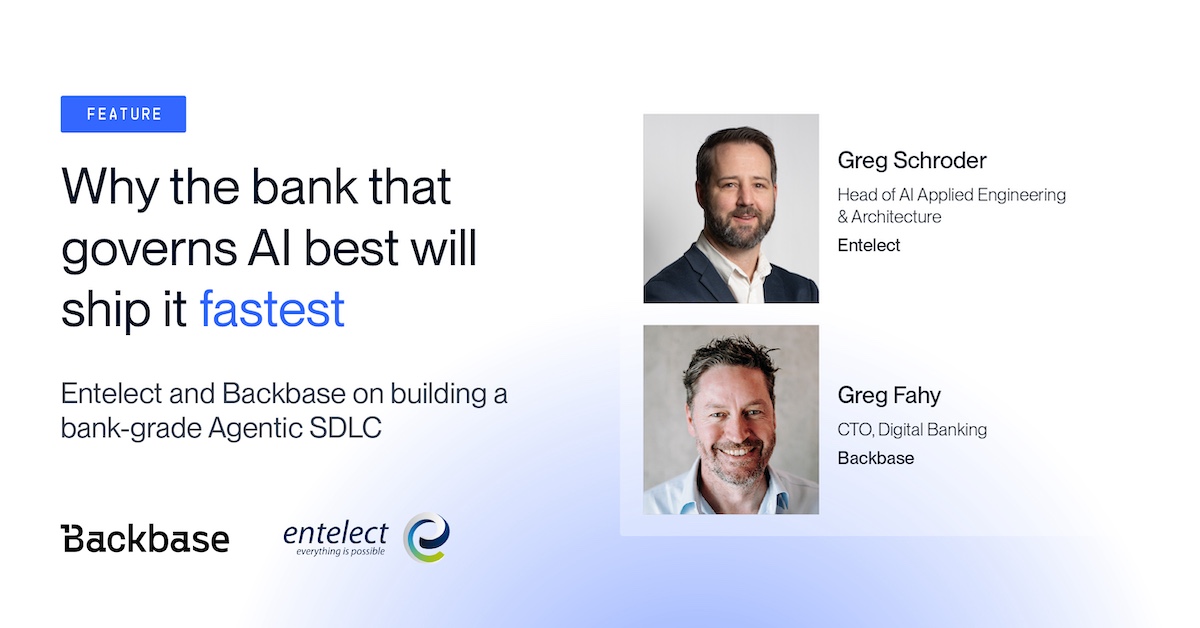
Greg Schroder
Head of AI Applied Engineering & Architecture, Entelect
The culture of coaching
The first thing Schroder looks at is how often a team ships. If people are nervous about releasing to production, that tells you plenty about their delivery setup, and no amount of excitement about AI tooling changes it. He usually gets there with a single question: "How do you know when a change is safe to release?" If the answer is a long UAT cycle and someone signing a form, he knows AI is going to make the existing problems bigger. If it's automated checks and code review that actually happens, the team is probably in decent shape.
This isn’t about tools as much as it is about the working agreements a team has in place, and whether anyone follows them. Where is AI allowed to be used? Which repos can it touch? Who reviews what it produces, and how? At what point does a decision get handed to a person rather than left to the model? Most teams can answer these in a workshop. Fewer can point to them in a live pull request. Getting from the first to the second is most of what Entelect's coaching work is.
Making engineering discipline scale
Fahy sees the same fragmentation Schroder describes, but from the architecture side. "There is a high likelihood that if you have silos in your applications and enterprise architecture, you will have silos in your delivery pipeline," he says, a pattern built up over two decades of legacy transformation that never quite finished the job. A disciplined team inside that kind of pipeline still loses context the moment work crosses a system or team boundary. Fahy defines safety for AI-written code in two parts. It has to do what it's supposed to functionally, and it has to fit the wider system architecture, holding up under maintenance, security, and compliance over time.
“AI and agentic software development is creating a unique opportunity to overcome this constraint and finally address those unloved remaining fragments and silos.”
Greg Fahy
CTO, Digital Banking, Backbase
"I like to think of agents as my least experienced, but most teachable developer," Fahy says. A junior engineer gets pointed to a team's coding standards; an agent needs those same standards encoded as skills and evaluations precise enough to work on its own. That's the agentic SDLC in practice. Agents don't stop at writing code, they shape requirements into specifications and keep testing moving at the same pace. Shipping software means much more than producing code that happens to compile.
Backbase grounds this governance in three operational requirements an agent needs: context to understand the bank's domain, strict authority over what it can touch, and a dependable execution route through specification, testing and review before release. The audit trail is a Decision Token, a record of what an agent was allowed to do, under what constraints, and who approved the action. A coding agent operating this way could propose and test a change, but never merge or release it on its own authority.
"Enabling a whole team with high quality agentic capability across the SDLC is what drives the productivity and quality gain that organisations are striving for, and that's why we created Delivery Factory," Fahy says.
Neither half of this works on its own. Entelect brings the coaching and the standards that make AI use responsible. Backbase provides the platform architecture and the agentic SDLC capabilities of Delivery Factory that let that discipline scale across a bank's wider delivery pipeline without losing the human chain of accountability.
Where the two roles meet
If a bank could only fix one thing, which should it be? "I'd tackle the culture of engineering discipline first. That is where we’ve seen success in banks," Schroder says. "Engineers that care enough to hold themselves to a higher standard will, over time, address platform architecture as a natural byproduct of their endeavors."
Fahy adds a qualification. He has seen high-performing, disciplined teams create strong, sustainable architecture as an outcome of that discipline, but in his experience that's the exception rather than the rule. Tools and process help to scale the performance of that A-Team across larger organisations. "A very smart consultant once told me, 'Changing software is easy, changing people is hard,' and that’s as true today as it was back then," he says.
From AI-busy to AI-productive
A BCG survey from 2025 found that only about one in four banks had built AI into their core strategy, with the rest still stuck in siloed pilots. Asked what a bank has to do to join that quarter, Schroder points to shared context. "Banks that are creating safe pathways for sharing context within their organisation are going to pull ahead of the pack," he says. He means something more active than dusting off old architecture diagrams: treating institutional knowledge as something the bank actively captures and shares, so engineers and their AI assistants draw on the same collective intelligence instead of rediscovering it project by project.
"In a world where AI capabilities are increasingly commoditised, institutions that can safely harness their proprietary context will amplify every AI-accelerated initiative they undertake."
Greg Schroder
Head of AI Applied Engineering & Architecture, Entelect
The bank that governs its AI best will know which changes reached production, which controls they passed, and who stayed accountable for them. The advantage won't come from generating more code. It will come from proving that AI-generated work can reach production safely, repeatedly, and with accountability intact.
Watch it work
Governed AI delivery is easier to talk about than to run. Watch Greg Fahy's Engage session on Delivery Factory 1.0 to see it in practice.