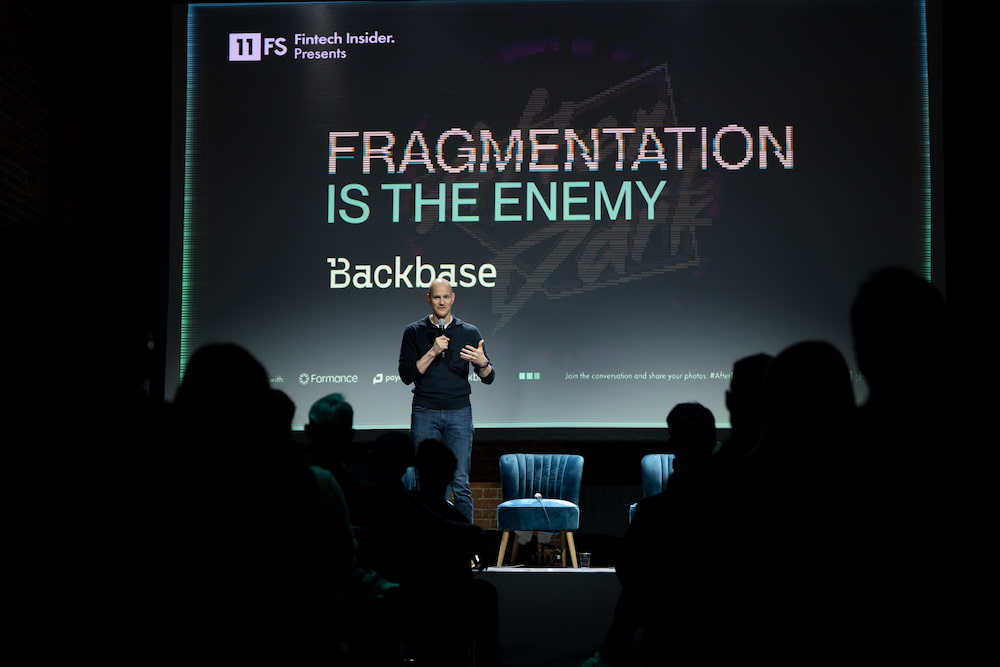
But here's what I've learned after 22 years building software for over 120 banks across 50 countries: the account is not the customer. And that distinction - which sounds almost philosophical - turns out to be the single most consequential architectural decision a bank can make right now.
Because we've hit the moment where account-centric architecture slows you down and actively prevents you from becoming an AI-native bank.
The fragmentation problem has been with us for decades - AI just made it much more prominent
At Backbase, we've always fought fragmentation. Our original vision was omnichannel - how do you unify the way the bank presents itself to customers across mobile, web, branch, and call center? We made real progress on that. A lot of banks did as well.
But channel fragmentation was always a symptom, not the disease. The real problem sits one layer deeper: the operating model itself.
Banks are organized around products, channels, and operations. Each of those units has its own budget, its own systems, its own logic, its own truth of who the customer is and what's going on. Nobody connects the dots across them. A retail banking group can optimize its mobile app. A contact center operation can tune its IVR. But holistically, end to end, nobody owns the customer's journey from intent to resolution. That's Conway's Law in action - your software architecture mirrors your org chart, and your org chart was drawn to protect product P&Ls, not to serve customers.
The result: more than half of frontline work lives in the whitespace between systems. The handoffs, the exceptions, the manual coordination that no single system owns. That's where most of the cost sits. That's where most of the delays happen and where operational risk concentrates.
This was already a serious problem before anyone even mentioned agentic AI. You could make a compelling case for fixing it on operational efficiency grounds alone. But now that we're putting AI agents into the picture, the fragmented operating model stops being a drag and starts being a blocker.
Agents can only reason as well as the context they're given. If the truth about a customer is scattered across 50 to 100 backend systems - each calling the customer entity something slightly different, each holding a fragment of the real picture - you can't give an agent the context it needs to make a good decision. You can't govern it properly. You can't explain its actions to a regulator or a risk team. You end up with AI that's fast but wrong, or you end up killing it after the pilot, not deploying it at all.
Three things have to be in place for this to change
Moving from account-centric to customer-centric is a strategic commitment with three distinct prerequisites.
First - a unified customer truth layer.
Every bank has a data lake. Every bank has a CRM. Most banks have a dozen more systems that each hold a slice of customer reality. The reflex for the last 20 years has been pass-through architecture: pull the data you need, display it, push decisions back to the system of record, never persist anything in the middle. Don't duplicate data. That was a practice for a different era.
To operate as an AI-native bank, you need to break that rule deliberately and intelligently. Not by replacing your cores - that's a decade-long nightmare nobody needs. But by building an ontology: a common business language that maps across all your backend systems and defines, once, what a customer is, what a product is, what a relationship looks like. You bind your existing systems to that ontology and build what we call a customer state graph - a single, always-updated view of the customer that any channel, any employee workspace, any AI agent can query instantly.
This is the move from account-centric to customer-centric. The customer becomes the core artifact, and everything - accounts, products, policies, history - hangs from the customer rather than the other way around.
Second - a decision ledger.
There's something banks been throwing away for decades without realizing its value. Every customer journey - onboarding, a loan application, a dispute - involves dozens of decisions. KYC checks. Credit scores. Address verifications. Policy overrides. At the end of that journey, banks typically record only the outcome: this customer was approved, this account was opened, this is the balance. The decisioning history - why we made each call, what the score was, what policy applied - gets lost along the way.
That historical trail is absolute gold for AI. It's the context an agent needs to make a good future decision. It's the audit record a regulator will eventually ask for. It's the difference between AI that reasons from full context and AI that guesses from partial data. A decision ledger - a persistent, time-series record of every decision made in every customer journey - turns historical data from a liability into an asset.
Third - organizational alignment above the org chart.
This is the hardest one: it requires the Chief Digital Officer, the Chief Operating Officer, and the heads of the business units to sit down together and agree to optimize for the customer's end-to-end outcome rather than their own domain's metrics.
That's fighting Conway's Law directly. It's uncomfortable. Budgets don't work that way. Incentives don't work that way. But without it, the technology doesn't matter. You can build the most elegant customer state graph in the world, and a siloed org will still find ways to fragment the experience on top of it.
Stop and watch - what a mortgage exception looks like today
A customer opens their bank's app on a Tuesday morning and applies to refinance their mortgage. The intent is clear, it's captured digitally, and for the first part of the journey, things work perfectly fine. The form is clean. The initial credit pull comes back fast.
Then the edge case hits. There's a flag on the account - a name discrepancy between the mortgage application and the ID on file. Automated flow stops. The customer gets a message: someone will be in touch.
The next morning, a call center agent picks up the case. They log into their servicing system. It shows the mortgage application reference number but nothing about the ID discrepancy - that flag lives in the compliance system. They open the compliance system. They find the flag but can't see the original application documents - those are in the document management system. They open that. Twenty minutes in, they've touched seven systems, and they still don't have the full picture. They escalate to the branch. The branch has yet another system.
The customer waits four days. The bank has spent significant staff time on what is, at its core, a routine name-matching problem.
Now redesign that with a customer truth layer in place. The agent - human or AI - opens a single workspace. The customer state graph has already pulled the relevant context: the application, the ID record, the flag, the prior KYC history, a record of the last time this customer had a similar discrepancy resolved two years ago. The decision this needs - match confirmed, proceed - takes two minutes. The customer gets a notification the same afternoon.
This isn't a hypothetical. Banks running on unified frontline architecture are seeing execution times drop by 50 to 90% on these kinds of cases. The drag in the old model comes down to architecture. Account-centric systems don't know how to hand context across to each other because they weren't built to.
The next 10 years belong to the operating model
For roughly the last decade, the battle in banking was about user experience. Who had the best app, the cleanest onboarding flow, the most intuitive mobile payments. Revolut, Monzo, and N26 set the standard, and the industry scrambled to catch up. A lot of banks did catch up, at least on the surface.
That battle is mostly over. It's now about what happens behind the interface when a customer's intent touches something that can't be resolved in a second.
I'll say something that might sound controversial. I think you can run a bank with 500 people and serve 5 million customers - IF you have the right architecture. Through a fully agentic operating model where thousands of AI agents handle advisory conversations, guide customers through complex decisions, execute compliance checks, and process disputes - all under governed authority, all with full audit trails, all operating from shared context.
It might sound like a science fiction, like Elon Musk talking about taking people to Mars, but it's the logical endpoint of what we're already seeing in early deployments. And it has a profound competitive implication: the institutions most aggressive in pursuing this efficiency will lower their cost base and at the same time force every competitor to answer the same question.
The banks that refuse to ask it are making the same mistake classic retailers made when they told themselves e-commerce was a niche. There will be a tipping point. The fragmented operating model - hundreds of applications, thousands of people navigating between systems - is not sustainable as a competitive structure in the era of agentic banking. The economics will break.
AI agents are joining the workforce and scaling by the day. The banks that can give these agents full context, governed authority, and a shared truth to reason from will pull far ahead of the ones that can't. But agents operating inside a fragmented, account-centric architecture don't get smarter over time. They get faster at producing inconsistent answers. And that's a risk that makes every compliance officer nervous for good reason.
The shift from account-centric to customer-centric requires a fundamental rethinking of what the bank considers its core artifact and its core organizing principle. The customer - with full context, full history, and a complete record of every decision ever made about them - becomes the atom around which everything else is structured.
That's a different bank. It's a harder bank to build. But it's the only architecture that makes AI actually work at scale.
The practical questions to take back
- When a frontline agent handles an exception today, how many systems do they touch before they have the full customer picture?
- Where does decisioning history go after a customer journey completes - and could you reconstruct why a specific decision was made 18 months ago?
- How many different definitions of "customer" exist across your backend systems right now?
- Do your Chief Digital Officer, Chief Operating Officer, and business unit heads share a single metric for frontline outcome - or does each optimize for their own domain?
- If you were to deploy AI agents in your mortgage servicing operation tomorrow, what context could you actually give them?
I recently had a great discussion with Dr. Efi Pylarinou about this, watch the full talk here: