Why the hybrid advisory model breaks down in wealth management
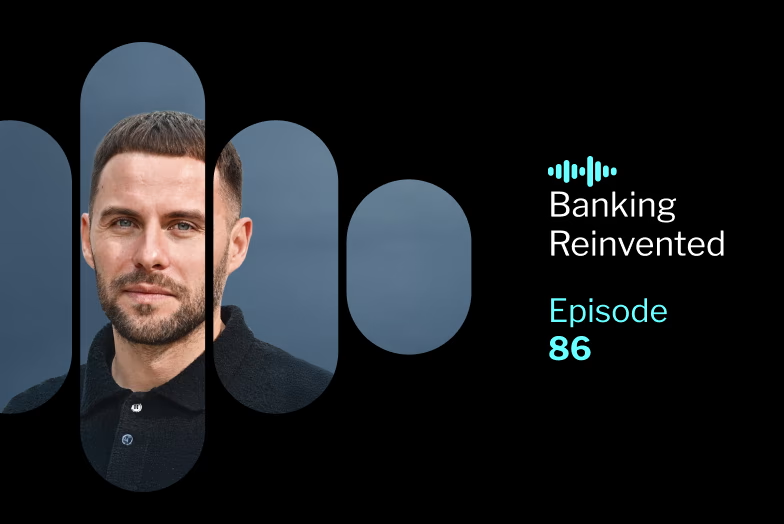
Mindaugas Vaičiulis has seen this problem from the inside. As Head of Technology and Senior Vice President at Danske Bank - leading the Wealth Planning and Investments Tribe across advice, investing, and portfolio management - he sits at the intersection of exactly this challenge.
Danske is one of the most digitally advanced wealth operations in the Nordics, with heavy investment in advisor tooling and an active program to scale high-quality advisory from private banking clients down to retail.
In an an episode of the Banking Reinvented podcast, he told host Tim Rutten: "When we're talking about hybrid, it doesn't really exist. It's kind of stitched together."
This is a precise diagnosis of where the industry is - and why.
How wealth management platforms were built to stay separate
Digital wealth experiences grew out of self-service logic. Every feature was justified by a business case - hours saved, calls deflected, tasks completed without human intervention. That discipline produced genuinely useful tools: goal trackers, portfolio views, retirement calculators, product recommendations. But it also produced a specific emotional register that is efficient, task-oriented, and transactional.
The advisor relationship grew from an entirely different origin. It is built on presence, trust accumulated across years, and a tone of voice that knows when to probe and when to listen - the kind of context that only builds when someone is actually paying attention to you over time.
Both modes are valuable, but they remain disconnected.
According to Mindaugas, the reason behind this fragmentation is that digital banking originated as self-service - features built around a business case, interactions built around a button. The advisor experience is built around something the digital channel has never been designed to replicate: the vibe, the tone, the feeling of being with someone who genuinely knows your situation.
The middle ground between those two experiences - where the digital context travels into the human conversation and back again - is where most banks are still building. The bridge, as Mindaugas put it, is not fully there yet.
Fragmented systems are breaking the wealth client experience
Clients do not experience channels. They experience a relationship. And right now, most digital wealth management platforms are delivering two separate relationships and asking clients to hold them together.
The digital relationship knows what the client clicked, what goal they set, and what recommendation they reviewed. The human relationship knows what the client said, what worried them, and what they almost asked. Neither knows what the other knows.
Every channel switch carries a small tax - a repeated question, a piece of context re-explained, a recommendation that doesn't account for the conversation the client had last week. Each moment is individually forgettable, but cumulatively they erode the one thing that wealth management runs on: the sense that the bank actually knows you.
This is neither a UX problem nor a training problem. It is a data problem, and underneath the data problem, it is an architecture problem. The digital channel holds its version of the client. The advisor workspace holds a different version. Operations holds another.
Each system carries part of the truth but no single surface holds all of it, and no single source governs what the client's actual state is right now, across their full relationship with the bank.
Fragmented systems are not just failing the technology, but also failing the relationship.
What AI in wealth management requires to work
The industry conversation about AI in wealth banking has focused heavily on advisor efficiency - meeting preparation, automated transcription, documentation that writes itself. Mindaugas shared in the podcast episode that Danske Bank is already working on AI-assisted transcription that changes the quality of advisor presence in meetings.
"I don't need to worry about taking notes. I'm actually there with you. I'm listening to you. I'm here to give you advice," he said, commenting on the how freeing advisors from admin work with the help of AI will positively influence relationships with UHNW clients.
But Mindaugas was explicit that efficiency is not where his excitement lies. The more significant AI opportunity in wealth - and the one he described with genuine specificity - is in the client experience itself.
"The most exciting part of all of this AI buzz for me is definitely not about efficiency and operational benefits. It's really rethinking how to get somebody that's going to be completely different - where ultimately you have an advisor with you always and your mobile app gives you an experience instead of being a selection of buttons."
He described a near-term vision of personalized morning market notes delivered to every client's phone, powered by AI that has analyzed their specific portfolio composition, sectors, and regions - voiced portfolio reviews and quarterly performance summaries delivered by an avatar, capabilities that are currently exclusive to the most expensive private banking relationships made accessible digitally to every client.
"It's not going to be so long before every single customer will get those notes every morning in their mobile - looking at your portfolio, what's the composition, what are the sectors, what are the regions."
These features matter, but they land on top of whatever architecture the bank already has. An AI that delivers a personalized morning briefing drawing from a portfolio view that doesn't match what the advisor discussed last week does not close the gap. It adds a new surface to an existing architecture of seams, and the AI becomes one more version of the client rather than a reflection of a unified truth. AI in wealth management does not fix fragmentation. It inherits it.
Fragmentation is the problem. A unified operating model is the fix.
Wealth management's digital-human gap has been framed for years as a tension between scale and quality - the idea that you can reach more clients or serve clients well, but not both. The tension is not between scale and quality. It is between a fragmented operating model and a unified one.
Mindaugas did not describe his vision for closing that gap in terms of technology. He described it in terms of feeling: "It all comes down to making it feel like it's one seamless, continuous conversation that you're having with your bank."
That is an interestingly simple ambition for an industry that has spent a decade building impressive tools on either side of a seam it never fully closed. It requires that every interaction - the goal a client sets on a Sunday evening, the concern they raise with their advisor on Tuesday, the portfolio note they receive on Wednesday morning - builds on the one before it, regardless of which surface it happened on.
The personalized AI experiences he described - the voiced morning notes, the portfolio reviews, the digital proposals - are expressions of that ambition. But they only deliver on it if the infrastructure underneath them is unified.
When both the advisor and the app operate from the same version of the client, every interaction compounds the relationship instead of resetting it, and advisory scales without losing the quality that makes it worth having.
How the Banking OS unifies the digital wealth management platform
This is precisely the problem the Backbase AI-native Banking OS is designed to solve, and specifically what the Unified Frontline means in wealth banking.
The Unified Frontline is the operating model where customers, employees, and AI agents work as one because every actor, every channel, and every surface operates from the same foundation.
At the center of that foundation is the Customer State Graph - the single, continuously updated operational truth about every client. It is not a static profile or a CRM record that was last updated before the most recent meeting. It is a live, governed view of the client's goals, holdings, conversations, in-progress journeys, and life events, held in one place and accessible to every surface simultaneously.
When the RM Workspace opens a client, it is not opening a different view of that client than the app carries. It is opening the same Customer State Graph - enriched by everything the digital channel captured, governed by the same policies, and informed by the same embedded intelligence. As a result:
- The advisor does not reconstruct the relationship, but continues it.
- When a client opens the app after an advisor meeting, the conversation is already reflected.
- What was discussed is visible, what was agreed is surfaced, and what remains outstanding is waiting for action.
- When an AI agent delivers a morning portfolio briefing, it draws from the same Customer State Graph that the advisor reads from.
This is what the Banking OS - as the Control Plane of the Unified Frontline - makes possible by providing one unified execution environment where digital, human, and AI are all expressions of the same operating model. For a deeper look at how leading banks are structuring this foundation, see our guide to the digital wealth management platform.
Learn more about the economics of a unified wealth operating model
Frequently asked questions
Why do digital and human wealth advisory still feel disconnected?
Most banks built their digital channels and their advisor tools on separate systems at different points in time. Each holds its own version of client data. When a client switches between the app and their advisor, context does not automatically travel because the advisor has a different view of the client than the digital channel captured. Closing this gap requires a unified operating foundation, not just better UX on top of fragmented systems.
What is a Customer State Graph in wealth management?
The Customer State Graph is the single, continuously updated operational view of a client - their goals, holdings, conversations, decisions, and life events - held in one place and accessible to every surface of the bank simultaneously. Unlike a static client profile or a CRM record, the Customer State Graph updates in real time as the client interacts across digital channels, advisor meetings, and AI-assisted touchpoints. It is the foundation that makes a continuous wealth relationship possible.
How does the Unified Frontline apply to wealth banking?
The Unified Frontline is the operating model where customers, employees, and AI agents work from the same foundation - the same client state, the same policies, the same execution environment. In wealth banking, it means the RM Workspace and the client's digital app are both expressions of one operating model rather than two separate products. Every interaction, regardless of channel, updates the same Customer State Graph and informs every subsequent interaction.
What is the role of AI in closing the digital-human gap in wealth management?
AI accelerates the gap if the architecture underneath it is fragmented, adding more surfaces and more inconsistency. AI closes the gap when it operates from a unified client state. In wealth banking, the most valuable AI applications - personalised portfolio briefings, voiced performance reviews, meeting preparation agents - only compound the relationship when they read from and write to the same Customer State Graph that the advisor and the digital channel use. Architecture determines whether AI adds continuity or adds noise.
What is a hybrid advisory model in wealth management?
A hybrid advisory model combines digital self-service with human relationship management, letting clients move between an app and an advisor for the same relationship. In practice, most banks run it as two disconnected systems: a digital channel that knows what a client clicked, and an advisor who knows what they said, with no shared view between them. A true hybrid model requires both to draw from the same client state in real time.


.jpg)