Private banking is bracing for Gen Z, but most banks are preparing for the wrong thing.
The industry narrative goes like this: Gen Z wants everything digital. They don't value human relationships. They'll take their wealth to robo-advisors and never look back.
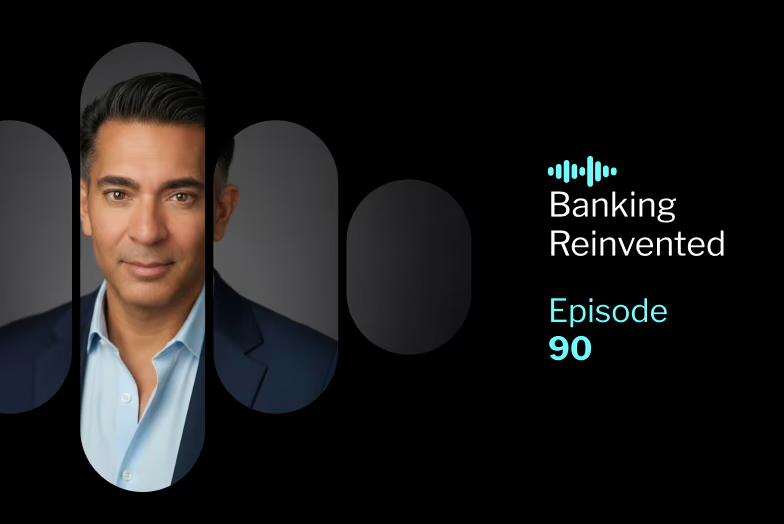
Rom Atapattu thinks we've got it backwards.
Rom is the Co-founder and Group CEO of Patronus Group. He spent 25 years working at institutions including Mirabaud, BNP Paribas Fortis, and Deutsche Bank before founding Patronus Wealth and Banque Patronus, operating across Dubai and Mauritius. In episode 90 of Banking Reinvented, we talked about what's actually changing as wealth transfers to the next generation.
His take? The fundamentals of private banking aren't disappearing. But how you deliver them needs to change completely.
The gap between perception and reality
Rom's perspective comes from being on both sides. He's worked inside traditional institutions and built a bank from scratch for today's clients. That dual view shows him where private banks consistently miss the mark.
First: confusing digital with impersonal
Most banks interpret "digital transformation" as reducing human contact. Build an app, cut back on relationship managers, automate everything possible.
But younger clients want something different. They expect effortless self-service for routine tasks and immediate access to expertise when things get complex. They want to check their portfolio at 2am without calling anyone. But when they're thinking about selling the family business or restructuring their wealth, they want a relationship manager who actually knows them.
A Simon-Kucher study of high-income earners found something revealing: over 60% of those aged 18-40 saw unique value in personal interactions, and 78% were willing to pay a premium for it. The assumption that younger generations want less human contact? It's wrong. They want more meaningful human contact, freed from administrative friction.
During our conversation, Rom emphasized that most client conversations aren't actually about money. They're about life transitions, family dynamics, legacy, and values. The financial piece is almost secondary to understanding someone's complete situation.
The technology should handle the administrative burden so relationship managers can focus on those conversations that matter. This is the same argument the RM productivity gap in private banking and freeing relationship managers to perform make in more depth: Modern platforms that unify workspaces and surface insights let RMs spend time on relationships instead of data gathering. That's elevation, not replacement.
Second: leading with products instead of outcomes
Traditional private banking leads with structure. Here's our discretionary mandate offering. Here are our credit facilities. Here's how we do things.
But clients increasingly care more about outcomes than products. They want to understand how financial decisions connect to their broader goals, their family dynamics, their values. Banks that start with "what are you trying to achieve" before pulling out the product catalogue have a better shot at winning these relationships.
The shift is from product-centric to client-centric, and the difference shows up immediately in how conversations go. But there's another assumption banks make that's just as outdated.
Third: assuming wealth stays in traditional centers
Switzerland. London. Singapore. The assumption is that serious private banking happens in established hubs.
Rom built Patronus deliberately across Dubai and Mauritius, two markets that reflect where wealth is actually moving. According to the Henley Private Wealth Migration Report 2025, the UAE is projected to see the largest net inflow of high-net-worth individuals globally, with millionaire migration patterns shifting dramatically toward the Middle East and Indian Ocean corridor.
In a recent interview, Rom explained the strategic logic. Mauritius serves as a hub for African investments while the UAE provides quick global reach. The two markets complement each other, with Mauritius ideal for fund structuring and accessing African markets, and the UAE offering rapid international connectivity.
The pattern he's responding to is real. Wealth is increasingly global from the start. Families have business interests across multiple continents, property in different regions, and investments everywhere. They don't want to hear "we don't operate there" or "you'll need to work with our other office."
This multi-jurisdictional complexity requires both sophisticated platform infrastructure and relationship managers who understand different regulatory environments and cultural contexts. You can't automate it, but you also can't do it manually at scale.
What actually changes
The fundamentals of private banking don't change. Trust matters. Judgment matters. Understanding the complete picture of someone's life matters.
What changes is delivery.
Clients expect technology to work seamlessly. Real-time insights, proactive alerts, digital experiences that make life easier. But they also know the important decisions require human wisdom.
Patronus has built its approach around being selective and fast. As Rom described their philosophy: conservative on risk but fast and client-focused, with onboarding that moves quickly and doesn't drag on when something isn't the right fit.
That combination of speed and judgment only works when the infrastructure supports it. When relationship managers have tools that surface insights without creating noise. When clients can handle simple tasks themselves and get to their RM when complexity hits. When platforms handle compliance and data so humans can focus on relationships.
Who wins
Gen Z is already deciding which institutions understand them. They're consolidating relationships. And unlike previous generations, they're not staying with their parents' bank just because.
The numbers tell the story. Research from PYMNTS shows Gen Z switches banks two to three times more often than their parents. A Bank Administration Institute study found that less than half of Gen Z now use the same financial institution as their parents, down from 61% just two years earlier.
The firms that thrive will be those offering relationship managers backed by technology, transparency paired with deep expertise, and global reach that never sacrifices the personal touch.
The wealth transfer everyone talks about isn't really about the $84 trillion changing hands. It's about whether private banks can evolve to meet expectations that are genuinely different.
It's not about being less personal, it's about being differently personal. Not less human, but more meaningfully human, with technology handling everything that gets in the way of genuine relationships.
The banks that understand this won't just survive the generational shift. They'll define what private banking becomes next.
Explore Backbase's private banking solutions: backbase.com/segments/private-banking.
For the fuller picture of how digital and white-glove service work together, see how private banks winning UHNW clients deliver digital and white-glove service simultaneously and the ultimate guide to modern private banking.