Backbase
Retail banking sector turns to financial wellness apps, as digital- only players snap at their heels in a race for digital supremacy
Retail banking sector turns to financial wellness apps, as digital-only players snap at their heels in a race for digital supremacy
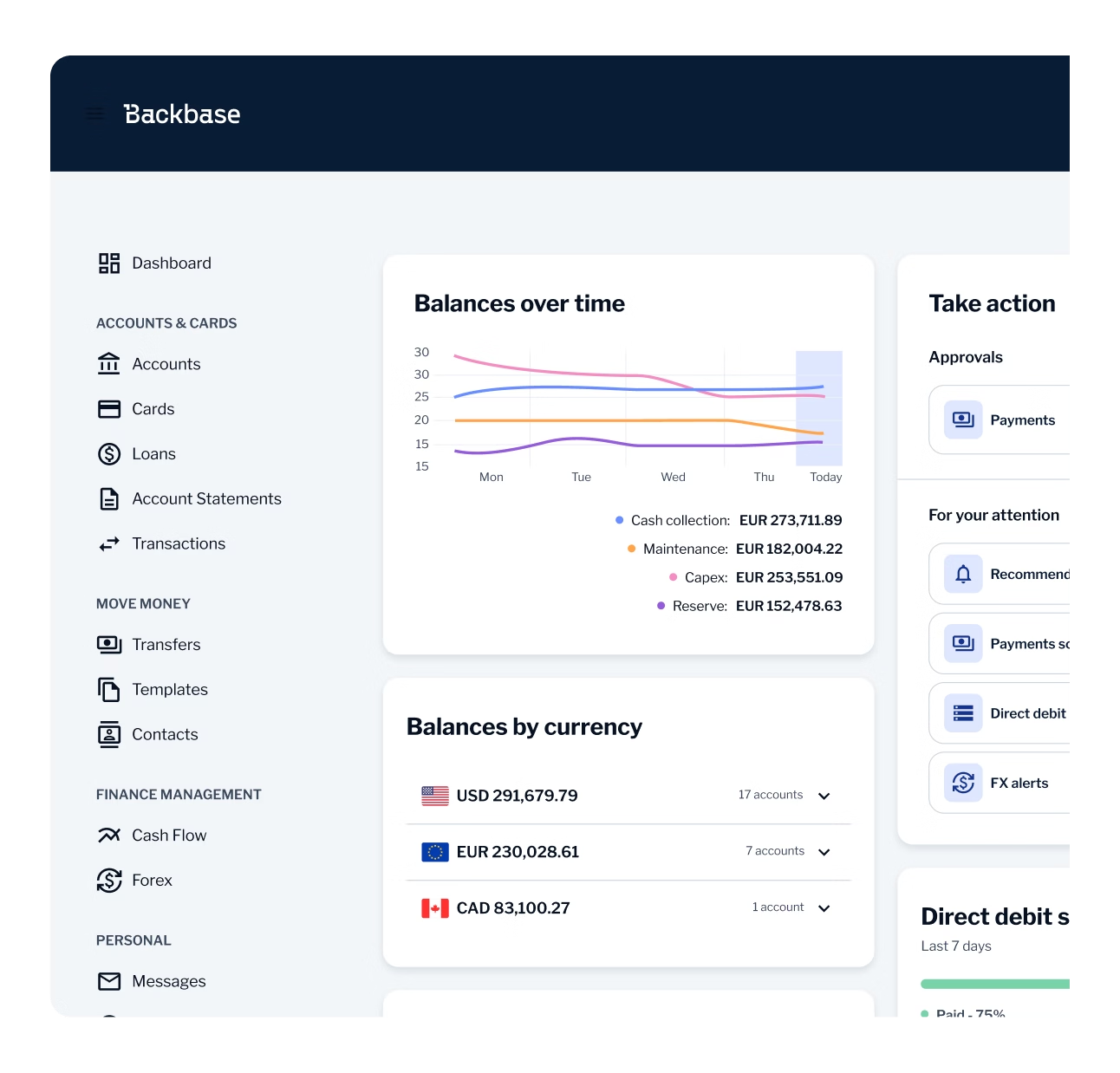

New data revealed in a Backbase commissioned study conducted by Forrester Consulting published this week shows Singapore’s retail banking sector is struggling to keep its lead against digital-only disruptors and soon-to-launch digital banks, as consumers demand more digital services, including financial wellness and digital money management tools.
Once the realm of mobile-only digital payment providers and soon-to-launch digital banks, financial wellness apps are now ‘ground zero’ in the battle between the various players in the retail banking sector.
Commenting on the findings from the study, Iman Ghodosi, Regional Vice President for Backbase in Asia Pacific said: “Our research shows Singaporeans are the most digitally serviced when it comes to banking in APAC – more so than Australia or Japan – which makes the race for digital dominance between traditional banks and soon-to-launch digital banks all the closer.”
“It’s no wonder the retail banking sector is putting its foot on the accelerator and injecting another 70% additional spend into this area over the next 12 months, according to the study.”
Unlike other countries in APAC, the data shows that in Singapore consumer adoption and demand are very much driving the changes. Of the consumers who took part in the study, 74% of them have used their institution’s existing mobile app compared to a regional APAC average of just 50% . 86% conduct their day-to-day banking via their smartphone, far higher than the regional average, and higher than Japan or Australia.
In consideration of the role they would like financial institutions to play in their lives, 55% of Singaporeans believed it was ‘critical’ that their financial institution assists them in managing their money through digital tools, compared to a regional average of just 32%. Also, 72% want their financial institution to make personalized recommendations, based on their financial situation, to improve their financial wellbeing – well above the regional average. A massive 88% believed ‘excellent mobile app experience’ is an attribute they value from their financial services provider.
Keeping up with this insatiable appetite, Singapore’s retail banks are responding. Of the Singaporean retail-banking business decision-makers interviewed as part of the report, 96% said they were planning to or actively expanding their digital financial wellness offering. Of these respondents, 64% said it was of critical priority.
The fintech wolves are at the door
“The urgency, focus, and action are as a result of the next wave of neobanks, fintechs and disruptors waiting to take market share,” Mr Ghodosi adds, who sees the next six months as an inflection point in the space. “Digital technologies can provide an aggregated view, along with alerts and insights across multiple accounts, and the likes of Grab are all gaining traction and market share amongst Singaporeans.
“Now more than ever, it is important to own the relationship with your customer. We’ve now entered the Engagement Banking Era, an evolution that stresses a one unified platform approach for banking. The number one priority in this new era is to completely re-architect the bank around the customer, moving away from siloed technology investments. At Backbase, we help banks to adopt and build modern, cloud-native banking platforms to keep pace with changing consumer demands, gain a 360 degree view into banking behaviours, and grow market share across all lines of business. We focus on customers before products, and create digital money management tools that match individual needs.”
Challenges for the sector do loom, unfortunately. Of the Singaporean retail-banking business decision-makers interviewed, 60% said outdated, legacy technology scuppered plans, 66% said a ‘lack of understanding of customer needs and outcomes’ is a barrier to their company implementing or further developing digital money management tools, and 52% said ‘competing priorities’ slows things down. Luckily, the challenges faced by Singapore’s banks were far lower than other areas of APAC.
“One can see how fintechs have a head start”, Mr Ghodosi added. “There is also a lack of understanding within legacy institutions on who owns the budget for these types of initiatives. Is it considered customer experience? Is it corporate strategy? Or is it marketing? When in fact it is all three, and more.”
Protecting the vulnerable
One of the most interesting and, until now, hidden motivations of retail banks for increasing spend and focus in this area, is the increased capacity for them to care for and protect their customers. Through this new channel of customer interaction, banks can now meet needs that they previously couldn’t, by leveraging data analytics and making subsequent recommendations to the users.
For example, 78% of retail banking business decision-makers interviewed mentioned that ‘preventing exploitation of vulnerable and older customers’ was in their company’s plans –far higher than the regional average. 74% said they plan to ‘assist customers to build better financial habits’, and 64% are going to ‘proactively help customers with financial distress’. Something that may be seen as favourable when it comes to Environmental, Social, and Corporate Governance reporting that banks must adhere to.
Other more specific tools also mentioned included ‘setting up automatic savings’ (80%), ‘advanced pay and income smoothing’ (78%), and ‘budgeting assistance’ with 76% of decision-makers mentioning it was something that their company was planning.
“The data points to financial wellness apps being a primary interface between banks and their customers as we move into the future. As a market leader in engagement banking platforms enabling the disruptors of the banking industry and incumbents alike, Backbase is primed to address this real need. Our unified engagement approach is helping banks to launch modern, cloud-native banking services that keep pace with change, while offering superior customer experience for both consumers and employees across all touchpoints and all lines of business of the entire bank.”

Backbase built the AI-native Banking OS - the operating system that turns fragmented banking operations into a Unified Frontline. Customers, employees, and AI agents work as one across digital channels, front-office, and operations.
Backbase was founded in 2003 by Jouk Pleiter and is headquartered in Amsterdam, with teams across North America, Europe, the Middle East, Asia-Pacific, Africa and Latin America. 120+ leading banks run on Backbase across Retail, SMB & Commercial, Private Banking, and Wealth Management.